Every commercial vehicle power unit under 49 CFR 393.95 must carry a fire extinguisher “securely mounted to prevent sliding, rolling, or vertical movement relative to the motor vehicle” and readily accessible. A commercial vehicle fire extinguisher mount meets that duty. F4Fabrication laser-cuts 3mm steel brackets for each make and model that bolt to factory seat rails, quoted for vans, box trucks and semis.
The DOT fire extinguisher mounting requirements for commercial vehicles are two conditions in 49 CFR 393.95(a), a Federal Motor Carrier Safety Administration (FMCSA) rule for power units. The extinguisher must be:
The U.S. DOT and FMCSA do not approve or certify brackets, so compliance with DOT fire extinguisher regulations comes from how the bracket anchors and where it sits.
Two FMCSA fire extinguisher requirements apply to the mount: securement and accessibility. In practice, accessibility means the driver can reach the unit and release it from the bracket quickly.
The remaining commercial vehicle fire extinguisher requirements cover the extinguisher: an Underwriters Laboratories (UL) rating label, a charge indicator and a non-freezing agent. The minimum rating is one 5 B:C unit or two 4 B:C units, and 10 B:C on placarded hazmat vehicles. FMCSA’s CSA Safety Planner restates this list in section 5.1.4.
Every power unit that qualifies as a commercial motor vehicle (CMV) must carry a mounted fire extinguisher: trucks, truck tractors and buses, not trailers.
Under 49 CFR 390.5, an interstate vehicle is a CMV at 10,001 lb (4,536 kg) or more by weight rating or actual weight, or when hauling placarded hazmat. Vehicles built for 9 or more paid or 16 or more unpaid passengers, driver included, qualify.
Units towed in a driveaway-towaway operation are exempt. FMCSA rules, not OSHA 29 CFR 1910.157, govern fire extinguishers in commercial vehicles.
Roadside and pre-trip inspections check three things on the extinguisher mount: the unit is present, it shows a charge, and it sits tight in a reachable spot.
Commercial Vehicle Safety Alliance (CVSA) inspectors examine emergency equipment during a North American Standard Level I roadside inspection. The pre-trip inspection requirements in 49 CFR 392.7 name the same gear. Inspectors cite a loose strap under 49 CFR 393.95(a).
A vehicle fire extinguisher bracket stops sliding, rolling, and vertical movement with four parts: a bolted structural anchor, a cradle matched to the cylinder diameter, a closed strap or band clamp, and a steel body. The table maps each 393.95(a) phrase to the cylinder retention hardware that meets it.
Extinguisher weight class is the cradle’s fit parameter. One cradle spec per cylinder size keeps vertical movement restraint consistent.
| Rule wording | Bracket feature | Common failure |
|---|---|---|
| “prevent sliding” | Tensioned strap or band clamp | Loose strap |
| “rolling” | Cradle sized to 2.5, 5 or 10 lb class | Oversized cradle |
| “vertical movement” | Closed strap over the cylinder | Hook-style holder |
| “relative to the motor vehicle” | Bolts into seat rail, floor or bulkhead | Bracket fixed to trim |
| “readily accessible for use” | Quick-release latch in the driver’s reach | Cargo-area or rear-door position |
Bracket material and gauge set vibration resistance: a heavy duty fire extinguisher bracket in 3mm steel holds its shape. A metal fire extinguisher bracket of that gauge resists flex under road vibration. Buyers can compare fire extinguisher brackets for vehicles by anchor, cradle, strap and gauge.
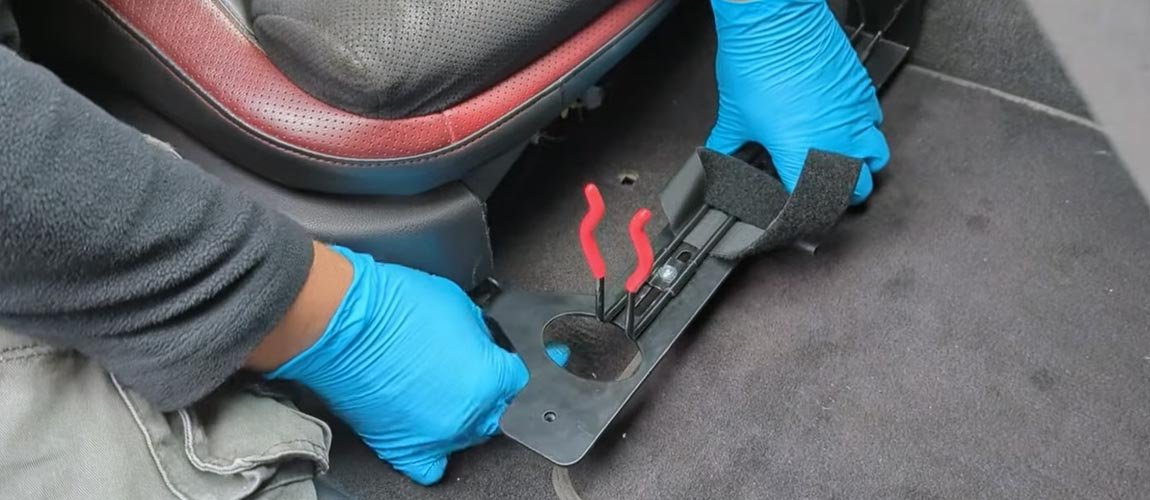
Mounting the extinguisher to the seat rails anchors it to the factory seat-rail bolts at the driver seat without drilling a single new hole. Drilled mounts need screws or rivet nuts in the floor pan, adding labor and bare-metal corrosion points. On a leased van, new holes can trigger damage charges at lease return.
Federal Motor Vehicle Safety Standard (FMVSS) 207 requires seat anchorages that restrain the occupied seat. A fire extinguisher seat mount bolts to that structure, not to thin sheet metal.
Seat-rail mounting is a no-drill installation method that leaves remarketed units with an intact cab floor. F4Fabrication brackets fasten to this seat-rail interface per listed model. The trade-off is fitment: each bracket matches one seat-rail pattern, so unlisted models need a custom design.
Commercial truck fire extinguisher mounts differ by each cab’s anchor point, while the rule stays the same: fixed to structure and within the driver’s reach. The in-cab mounting location of a fire extinguisher for commercial truck fleets follows each model’s vehicle anchoring interface. On box trucks such as the Freightliner M2 106, commercial vehicle extinguisher mounts bolt to the seat base or cab floor.
A semi truck fire extinguisher is mounted in the tractor (the power unit) at the driver seat base, behind the seat or at the sleeper entrance. Class 8 tractors are commonly fitted with air-ride seats, so the bracket should anchor to the fixed seat riser or cab structure, not to parts that travel with the suspension.
Carriers running two 4 B:C units need two secured positions. Unlisted tractors receive a fire extinguisher mount for semi truck cabs through a custom bracket request.
In a partitioned cargo van, the fire extinguisher is mounted on the steel bulkhead behind the driver or at the driver seat base. Upfitters set this position during the partition build on the Ford Transit, Mercedes-Benz Sprinter and Ram ProMaster. Cargo-area E-track holders sit behind the partition, out of reach.
A hotshot pickup needs a mounted fire extinguisher once the truck and trailer reach 10,001 lb or more, by rating or actual weight, in interstate commerce, because the rig then counts as a CMV.
No separate CDL fire extinguisher requirements exist: the duty follows CMV status, not commercial driver’s license class. A Ram 3500 carries the extinguisher at the driver seat base or on the cab floor, within reach. Unlisted pickups go through a custom bracket request. Personal-use and off-road pickups fall outside these rules.
Ordering a fire extinguisher bracket for vehicle fleets runs through one quote request: list each vehicle model with its model years and quantity, and F4Fabrication replies with a written quote. F4Fabrication designs its fire extinguisher brackets for commercial vehicles around model-specific fitment, so model and year decide which bracket each cab gets.
Listed work pickups and utes, such as the Toyota Hilux, Isuzu D-Max, Ford Ranger T6 and VW Amarok, are quoted from existing designs. Vans, semi tractors and vocational trucks without a listed bracket go through the same request as a custom design. Vehicle model, model years, quantity, company name, email and phone are the six fields on the fleet quote form.
Larger orders qualify for lower unit prices. Quotes for extinguisher mounts for fleet vehicles confirm the unit price, lead time, shipping from Klaipeda, Lithuania, duties and delivery terms in writing. Fleet standardization means one vehicle-specific bracket and one position per vehicle type, so audits check one spec.
A commercial vehicle fire extinguisher setup is complete when three parts match: a rated extinguisher, a reachable cab position and an anchored bracket. Extinguisher choice starts at the federal floor for commercial power units. Placement follows the vehicle layout for each extinguisher in the cab.
Leased and resold units gain the most from a drill-free seat-rail bracket, because the floor pan stays hole-free. Every F4Fabrication bracket is made from 3mm laser-cut steel, powder coated in Klaipeda, Lithuania, and shipped worldwide in USD.
Fleet mounts keep the extinguisher where 49 CFR 393.95 requires it: secured to the vehicle and within the driver’s reach. Owners of personal pickups can browse fire extinguisher brackets for trucks. Mixed-model operators ordering fleet and commercial vehicle extinguisher brackets can request a fleet quote.