Where to mount a fire extinguisher in a car comes down to one rule: fix it inside the cabin, within a belted driver’s reach, and secure it with a metal bracket that survives a crash. The right fire extinguisher placement in a car keeps the unit usable in the first seconds of a fire, while the wrong spot — the trunk, the dashboard, or a loose footwell — makes it useless or dangerous. This guide covers the best in-cabin location, driver reach, correct mounting height, crash-load retention, the positions to avoid, motorsport regulations from the FIA and SCCA, and how a no-drill bracket fixes the extinguisher without harming the bodywork. Reach, height, and retention decide the position; the sections below set each one in order.
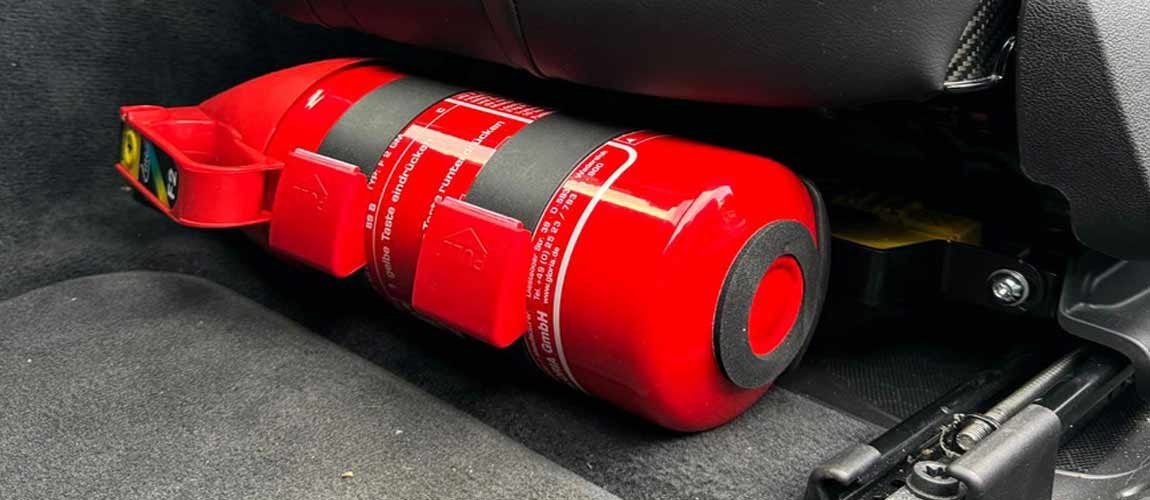
Mount a car fire extinguisher inside the cabin, within a belted driver’s reach — never in the trunk as the primary location. The best position is the front passenger footwell or the floor in front of the passenger seat, where the unit stays reachable yet clear of the pedals. Cabin placement keeps the extinguisher usable in the first seconds of a fire, before flames spread beyond control; the trunk works only as a secondary backup. A metal bracket bolted to the vehicle structure holds the cylinder secure during a crash.
Three cabin positions serve most vehicles: the front passenger footwell, the floor ahead of the passenger seat, and the transmission tunnel beside the driver — or a low under-seat mounting position where floor clearance is tight. Each keeps the handle and trigger inside the seated reach arc. A daily-driver owner gains a unit that grabs in one motion at a red light; a track driver gains a position that a scrutineer can verify from outside the car.
Do mount the extinguisher in the cabin where a seated driver reaches it. Avoid the trunk, the rear cargo area, and any spot blocked by a seat or a closed lid as the only location.
A car fire extinguisher must sit within the arc a belted driver can cover without leaving the seat. Reach is the primary placement decision and the core scrutineering test at motorsport events. The driver tests reach with the seatbelt or harness fastened, because a unit reachable only when unbuckled fails its purpose in a fire.
The reach envelope, not the floor space, sets the limit. A position that looks convenient when the driver leans across the cabin falls outside the arc once the belt locks during hard braking or a spin. Tuner and project-car owners who relocate seats should re-test the arc after every change, since a seat moved back by 50 mm shifts the reachable zone. The same constraint applies to a daily driver wearing a three-point belt: the unit must come to hand without unbuckling.
Test reach with a helmet and HANS device fitted, because both restrict head and torso movement. A position reachable bare-headed may fall outside the arc once a helmet and head-and-neck restraint limit how far the driver can lean. The HANS Device tethers the helmet to the harness, cutting forward travel by several centimetres, so race drivers confirm the grab with full gear on before an event.
A car fire extinguisher’s mounting height is set by the belted driver’s reach envelope, not by a fixed wall figure. Building rules such as NFPA 10 specify a wall height for portable extinguishers in fixed structures, but inside a car ergonomic reach replaces that number. Position the bracket so the handle and pressure gauge sit within fingertip reach from the seated, belted driving position — typically low on the transmission tunnel, in the footwell, or on the seat base rather than high on a pillar.
The contrast matters because owners often copy the building standard onto the car and mount the unit too high. NFPA 10 governs extinguishers fixed to a wall in a workplace or home, where a person walks up to them standing; in a car the driver stays belted and seated, so the reachable height drops to knee or seat level. Set the height by sitting in the seat, fastening the belt, and marking where the hand rests — that mark is the mounting height.
Secure a car fire extinguisher with a metal bracket that fixes to the vehicle structure at two or more points. Metal retention resists crash and hard-braking g-forces that would turn a loose cylinder into a cabin projectile; plastic mounts and velcro straps fail under those loads. The bracket holds the cylinder in a rigid cradle or latching strap and resists constant road and engine vibration, preventing rattle, valve damage, and gradual loosening.
A 2 kg cylinder under a 30 g crash load exerts roughly 600 N — about 60 kilograms of force — against whatever holds it. Metal anchored to the chassis transfers that force into the structure; a plastic clip or a strap of hook-and-loop tape releases the cylinder into the cabin. Track and tuner owners face the highest loads, but the same physics applies to a road car in a collision.
A compliant mount meets four requirements:
Metal resists crash g-forces and holds the cylinder when plastic flexes and velcro slips. Sanctioning bodies reject plastic and velcro for this reason, and a scrutineer fails any car using them. A steel bracket bolted to the structure keeps the unit fixed through impact and vibration alike.
A latching quick-release frees the cylinder with one hand while the other braces or steers. The latch retains the unit against vibration yet releases instantly when pulled, so the driver draws the extinguisher without looking down or using both hands.
Do not mount a car fire extinguisher on the dashboard, on the centre console, or loose under the driver’s seat. A dash or console mount blocks airbag deployment and can launch in a crash; a loose cylinder under the seat slides into the pedals and jams driver control. Avoid the trunk as the only location, because the driver cannot reach it during a cabin fire. Velcro and sheet-metal screws are not secure retention and fail motorsport inspection.
Each wrong position fails for a specific reason:
Motorsport bodies require a metal bracket, fixing at two or more points, and a verified reach test. The FIA Appendix J Article 253 governs international competition; the SCCA General Competition Rules, the NHRA Rulebook, and NASA rules set US club and pro requirements. Each mandates that a belted, helmeted driver can reach the extinguisher and that the mount survives crash loads — scrutineers fail any car using plastic brackets or velcro.
The four bodies align on the fundamentals while differing in detail. The FIA homologates equipment for international series; the SCCA and NASA cover US road racing and time trials; the NHRA sets drag-racing rules. All four inspect the mount at the bracket, the anchor points, and the reach, and they treat a metal two-point fixing and a belted reach test as the baseline. Drivers preparing for a first event should read the specific class rules, since cylinder size and system type vary by category. For broader equipment selection, see the best fire extinguisher for track days.
Motorsport bodies require a metal bracket, fixing at two or more points, and a verified reach test. The FIA Appendix J Article 253 governs international competition; the SCCA General Competition Rules, the NHRA Rulebook, and NASA rules set US club and pro requirements. Each mandates that a belted, helmeted driver can reach the extinguisher and that the mount survives crash loads — scrutineers fail any car using plastic brackets or velcro.
The four bodies align on the fundamentals while differing in detail. The FIA homologates equipment for international series; the SCCA and NASA cover US road racing and time trials; the NHRA sets drag-racing rules. All four inspect the mount at the bracket, the anchor points, and the reach, and they treat a metal two-point fixing and a belted reach test as the baseline. Drivers preparing for a first event should read the specific class rules, since cylinder size and system type vary by category. For broader equipment selection, see the best fire extinguisher for track days.
A handheld unit mounts in a quick-release bracket within reach; a plumbed system fixes the bottle to the structure and routes nozzles to the engine bay and cockpit. Many race classes require the plumbed system above a power or speed threshold, while club and street classes accept a handheld unit in a metal bracket.
A no-drill seat-rail mount positions the extinguisher low in the cabin, within the belted driver’s reach, by sharing an existing factory seat bolt. The bracket bolts to the original-equipment (OEM) seat-rail or seat-mounting bolt, so the cylinder sits at seat-base height — reachable and clear of the pedals — while the bodywork and resale value stay intact. Precision 3mm laser-cut steel brackets cut to a specific make and model hold the unit rigidly at that position without a single hole drilled in the shell.
This placement suits tuner and project-car owners who refuse to drill a clean shell, and it keeps the cylinder in the same reachable zone the regulations expect. Because the bracket is cut for one make and model, it aligns with the factory bolt pattern instead of forcing a universal clamp into an approximate fit. For the full fitting sequence, follow the step-by-step no-drill installation guide. To match the exact seat-rail pattern for your vehicle, choose the no-drill bracket made for your car.
Yes — you can legally and safely keep a fire extinguisher in a car year-round, provided it is securely mounted and rated for the cabin’s temperature swings. A charged automotive extinguisher tolerates normal in-car heat; a secured metal mount stops it rolling or becoming a projectile. Check the pressure gauge during routine service and replace or recharge the unit at the marked interval.
Most jurisdictions permit a vehicle extinguisher and many require one for commercial or competition use, though daily-driver owners should confirm local rules. Storage comes down to two factors: secure mounting and a unit rated for the temperature range a parked car reaches. A glovebox or footwell stick unit serves a road car, while a cylinder in a metal bracket serves a project or track car.
No — a correctly charged extinguisher does not explode at normal in-car temperatures, and its rated range covers typical summer heat. Most automotive units carry an operating range to roughly 49 °C (120 °F) or higher. Keep it out of direct sun where possible and check the gauge during service.
Mount an extinguisher rated for vehicle fires and sized to fit the bracket — most owners choose ABC dry-chemical powder, a clean-agent unit, or CO2. The agent type changes residue, cost, and electronics-safety, and a compact stick-format unit mounts where a full cylinder will not fit. Whichever agent you choose, it must sit in a metal bracket within the belted driver’s reach.
The full comparison of agents — car fire extinguisher types: powder vs clean-agent vs CO2 — covers which one suits your vehicle and how the ratings differ.
Mount the extinguisher in the cab within the driver’s reach for trucks, on a roll cage or grab bar for off-road vehicles and UTVs (utility task vehicles), and on the roll bar for convertibles that lack a fixed bulkhead. Commercial trucks in the US must carry a securely mounted, readily accessible unit under 49 CFR 393.95, enforced by the Federal Motor Carrier Safety Administration (FMCSA) — a duty that purpose-built truck fire extinguisher mounts satisfy. Classic cars with flat floors and bench seats suit a no-drill floor or seat-base bracket that preserves originality.
Each vehicle type adapts the cabin rule to its geometry. A truck keeps the unit in the cab, not the bed; an off-road UTV uses roll-bar placement brackets that clamp to tube without drilling; a convertible mounts to the roll bar where no roof structure exists. A low-profile classic or a car with limited floor clearance keeps the cylinder hidden yet reachable in a seat-base or under-seat mounting position.
Owners of older vehicles can browse classic-car fire extinguisher mounts built for flat-floor and bench-seat layouts.
F4Fabrications manufactures precision 3mm laser-cut steel, no-drill brackets engineered for each car make and model. The placement guidance on this page aligns with FIA Appendix J Article 253, the SCCA General Competition Rules, the NHRA Rulebook, and NASA rules, and with the broad consensus that a cabin-mounted, belted-reachable metal quick-release mount is correct. Each bracket shares the factory seat bolt, so the cylinder fixes to the structure at the strength the regulations expect without a single hole drilled in the shell.
This guidance supports a safe installation; it is not legal advice, and drivers should confirm the rules of their sanctioning body or jurisdiction before competition.
The right place to mount a fire extinguisher in a car is inside the cabin, within a belted driver’s reach, secured by a metal two-point bracket. Reach, mounting height, and crash-load retention decide the position; a no-drill seat-rail bracket delivers it without harming the bodywork. Match the bracket to the exact make and model, confirm the belted reach test, and the extinguisher stays usable when it matters. To fit one cleanly, find the no-drill bracket for your car and mount a fire extinguisher in your car without drilling a single hole.