A no-drill mount bolts to existing factory anchor points so it makes no new holes, while a drilled mount fixes the bracket by drilling new holes into the body. A no-drill fire extinguisher mount fastens to seat rails or seat bolts the vehicle already has; a drilled mount cuts new holes into the floor pan, transmission tunnel, or bulkhead and through-bolts the bracket to the structure. The two methods differ on one axis: whether the installation modifies the car’s body. No-drill bolt-in mounting preserves the bodywork and stays reversible, while drilled mounting produces a rigid but permanent anchor. For most road, tuner, classic, and leased vehicles the evidence favors a no-drill seat-rail bracket on resale, reversibility, and tech-inspection grounds, while drilling remains legitimate for dedicated race builds where permanence is acceptable.
The table below sets the two methods side by side across the decision factors this guide examines.
| Factor | No-drill fire extinguisher mount | Drilled fire extinguisher mount |
|---|---|---|
| Fixing action | Bolts to factory seat rails or seat bolts | Drills new holes, then through-bolts to the structure |
| New holes in the body | None | Permanent holes in floor pan, tunnel, or bulkhead |
| Reversibility | Removable, leaving the car unmarked | Treated as a permanent, irreversible modification |
| Resale and originality | Preserves factory-original condition | Can lower resale value on originality-sensitive cars |
| Installation effort | Hand tools, no power equipment | Drill, bits, deburring, and hole sealing |
| Tech inspection | Passes when metal, secure, two-point | Passes when metal, secure, two-point |
| Best-fit use | Daily, leased, classic, tuner, street-driven track cars | Dedicated race cars where rigidity outweighs reversibility |
This comparison runs across resale value, reversibility, tech inspection, crash-load retention, cost, and vehicle type, so an owner can match the method to how the car is used.
A no-drill mount is a bracket that fastens to pre-existing threaded points so no holes are drilled into the car. It anchors to factory seat rails, seat-mounting bolts, or a roll-bar tube using bolts or a supplied bolt kit. The method is also called a bolt-in mount because it installs with hand tools alone. A bolt-in fire extinguisher mount reuses anchors the vehicle already carries — seat rails, seat bolts, and roll-bar tubes — which is what keeps the fitting reversible and the bodywork untouched. Reusing a rated factory anchor, rather than creating one, is the defining feature that separates this method from drilling.
A drilled mount is fixed by drilling new holes and is treated as a permanent, irreversible modification. The installer drills into the floor pan, transmission tunnel, or bulkhead and through-bolts the bracket to the structure. Drilling produces a rigid anchor and lets a bracket sit almost anywhere in the cabin, including spots no factory thread reaches. Because the holes cannot be undone, the result is permanent: the structure carries the bracket directly, and the only way to remove the modification is to fill and refinish the metal. That rigidity and placement freedom are why drilling earns its place on dedicated race builds, even though it suits daily-driven cars far less.
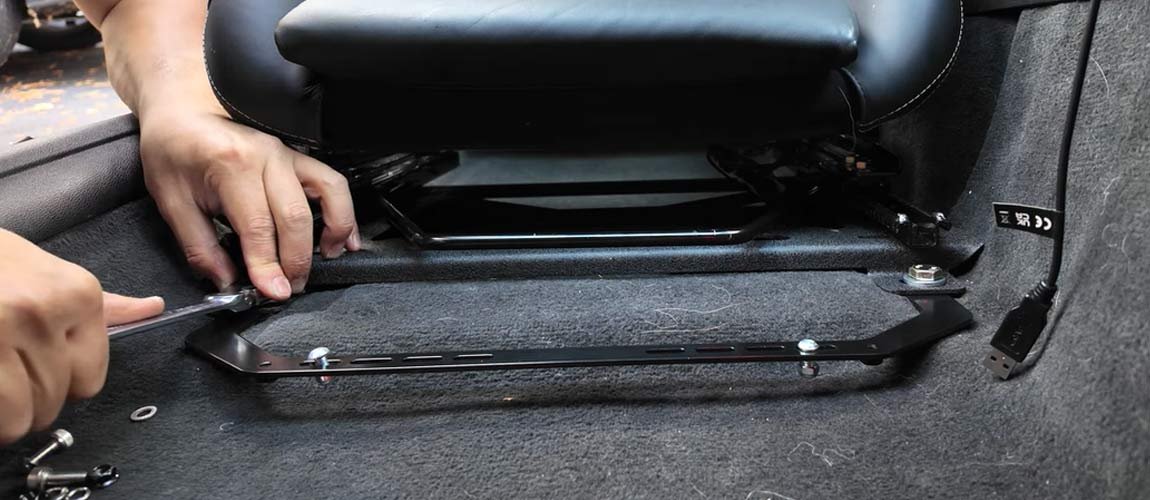
The factory seat rail provides a strong, OEM-rated bolt anchor, so a bracket can bolt straight to it without drilling. Seat rails and their mounting bolts are engineered to restrain the seat under braking and impact loads, which means the rail is a seat-anchorage-rated fixing point rather than a guess. Borrowing that anchor gives a fire extinguisher mount a rigid base beside the driver without piercing the body. A seat-rail bracket either bolts to the rail itself or shares the existing seat-mounting bolt, and an F4Fabrications seat-rail bracket shares that factory seat-mounting bolt, adding zero new fasteners. F4Fabrications cuts each bracket from 3mm laser-cut steel to one make and model’s exact geometry, which is what makes a true bolt-in, no-drill fit possible. A bolted seat-rail anchor carries crash loads through the same factory structure that restrains the seat, so its retention strength does not depend on drilled sheet metal. Caged cars that have no spare floor space use a different no-drill anchor: a roll-bar or roll-cage tube clamp that grips the cage instead of the rail.
Yes — a bolted-in seat-rail mount is strong enough when it uses graded fasteners correctly torqued. The mount transfers braking and crash loads into the vehicle through factory bolts or a supplied bolt kit, the same load path that already holds the seat, rather than relying on drilled sheet metal. High-strength fasteners and a threadlocking compound keep the bolts from working loose under vibration. A bolted-in anchor matches a drilled anchor for retention because both terminate in the same seat-anchorage structure, and the full crash-load and material comparison sits in the crash-retention section of this guide.
Drilling holes to mount a fire extinguisher can lower a vehicle’s resale value because the modification is permanent and visible to buyers. Used-car valuation references such as Kelley Blue Book and collector-car specialists such as Hagerty treat factory-original condition as a value driver, and drilled holes count against it — most sharply on classics and collector cars, where originality is decisive, and least on a track-only car a buyer already expects to be modified. A vehicle’s documented identity, tied to the VIN under standards such as ISO 3779, rests on its unaltered factory state, so unexplained holes invite buyer questions and can require modification disclosure at sale. Restoration programmes that trade on originality, including televised buy-and-sell formats such as Wheeler Dealers, repeatedly show original cars commanding stronger prices than altered ones. A no-drill seat-rail bracket leaves the body untouched, preserving originality and the resale position the owner started with — which for a daily-driver or leased vehicle often matters more than the marginal rigidity drilling adds.
Drilling can breach a lease or finance contract because most agreements bar permanent modifications and require original condition at return. It may also affect manufacturer warranty terms where the modification touches a covered system. A leased or financed vehicle therefore favors a reversible mount that leaves no trace at hand-back, since drilled holes can trigger end-of-contract damage charges. Owners should check the wording of their specific lease or finance agreement, because terms vary by provider. A bolt-in seat-rail bracket sidesteps the question entirely by adding no holes to return.
A no-drill fire extinguisher mount can be removed, leaving the vehicle in its original, unmarked condition. Because the bracket only bolts to existing factory points, the owner unbolts it and the car returns to exactly how it left the factory — no filled holes, no patched carpet, no corrosion scars. Drilling, by contrast, is treated as a permanent, irreversible modification: once the holes are made, they remain even after the bracket comes off. This reversibility is the main reason daily-driven, leased, and classic vehicles choose to mount without drilling, since the extinguisher can be carried when needed and the car restored to standard at sale or lease return. A collector protecting provenance and a leaseholder protecting a hand-back inspection both gain from the same clean removal. The only tools the owner needs to reverse a seat-rail install are the spanners or sockets used to fit it.
A no-drill mount is cheaper and easier to fit because it installs with basic hand tools and no power equipment. A drill-free seat-rail bracket needs only spanners or sockets to torque a few bolts, so most owners fit it themselves in minutes with little risk. On cost, a no-drill bracket is a bracket-only purchase: the spanners or sockets are tools most owners already own, so nothing else is added. Drilling adds tools, skill, time, and a real chance of damaging trim, wiring, or the floor pan: it requires a drill, the correct bits, deburring of each hole, and sealing of the bare metal that would otherwise corrode. Those drill bits, deburring tools, and sealant are extra outlays stacked on top of the bracket, so the drilled route carries cost drivers the bolt-in route does not. A ready-made drill-free bracket also removes the guesswork of locating safe drilling positions, where a misplaced hole can strike a fuel line, a wiring loom, or a structural member. For a DIY installer weighing tools against time, the bolt-in route asks for less of both, while a competition builder already set up to drill and seal metal absorbs that extra effort easily. The full step-by-step fitting procedure sits in the dedicated no-drill installation guide.
A no-drill mount passes tech inspection when it is metal, securely fixed, and anchored at two or more points. Scrutineers at track days and competitions verify three things before a car runs: the bracket is metal rather than plastic, the cylinder is held securely, and the mount uses at least two fixing points so it cannot rotate or work loose. A 3mm steel seat-rail bracket bolted through two factory points meets all three. Sanctioning bodies publish their own mounting rules, so entrants confirm the exact wording for their series before the event:
Both no-drill and drilled mounts can pass — the deciding factor is the bracket’s material and fixing, not whether holes were drilled. A velcro or strap-only fixing is the common failure point, because it can detach under load.
A scrutineer checks that the mount is a metal bracket, fixed at two or more points, retains the cylinder with a latching strap or clamp rather than velcro, and is reachable by a belted driver. The four checks map directly to the attributes a compliant mount must have:
A track-day entrant preparing a street-registered car and a dedicated racer face the same four checks, so a mount built to meet them clears scrutineering for either.
A no-drill mount holds securely under a crash when it is built from sufficient-gauge metal and bolted to a strong anchor with graded fasteners. The mount must resist braking and crash-load g-forces without releasing the cylinder, because an unsecured extinguisher becomes a cabin projectile — the reason retention strength is the deciding safety factor. A seat-rail anchor carries these loads through the same factory structure that restrains the seat, which is engineered to seat-anchorage standards such as FMVSS 207 and ECE R17, so the load path does not depend on drilled sheet metal that can tear. Retention strength rests on three things: a metal bracket of adequate gauge such as 3mm steel; high-strength bolts such as Grade 8 fasteners, rated under SAE J429 and ISO 898-1; and a locking method such as a threadlocking compound from Loctite or a wedge-lock washer from Nord-Lock to stop vibration loosening the joint. A quick-release strap or latch can retain the cylinder for fast deployment without sacrificing this hold. Fitted this way, a bolt-in mount matches the security a drilled mount provides for road and track use, while a dedicated race car may still prefer a drilled or welded anchor for maximum rigidity.
For most vehicles, a reversible no-drill seat-rail mount is the better choice; drilling is best reserved for dedicated race cars where permanence is acceptable. The decision turns on how the car is used. A daily-driver, leased, financed, classic, or tuner vehicle benefits more from preserved resale value, reversibility, and an untouched body than from the extra rigidity drilling offers. A dedicated competition car that is already modified gains little from reversibility, so a drilled or welded mount that maximizes rigidity is a legitimate choice there. Both methods can pass tech inspection and hold securely when built correctly, so the deciding factors are resale, reversibility, and how permanent the owner wants the install to be. Where the extinguisher sits inside the cabin is a separate decision, covered in the guide on choosing where the extinguisher sits in the cabin. The next section matches each vehicle type to its recommended method.
Most road and street-driven cars are best served by a no-drill seat-rail bracket; dedicated race cars can accept a permanent drilled or welded mount. Matching the method to the vehicle type keeps the install proportionate to how the car is driven:
A vehicle-specific seat-rail mount removes the fitment guesswork, because the bracket is engineered to one make and model’s exact mounting geometry. F4Fabrications produces these no-drill fire extinguisher brackets and laser-cuts seat-rail fire extinguisher mounts to fit individual makes and models, so an owner can find a no-drill fire extinguisher bracket matched to the car rather than adapting a universal part.
No-drill and drilled fire extinguisher mounting both secure the cylinder, but they differ on whether the install touches the car’s body. A no-drill seat-rail bracket bolts to factory points, makes no new holes, stays fully reversible, protects resale value, and passes tech inspection when built from sufficient-gauge metal — which is why a bolt-in mount suits most road, classic, tuner, and leased vehicles. Drilling delivers a rigid, permanent anchor that earns its place on dedicated race cars where the build is already permanent and rigidity is the priority. For the majority of owners weighing no-drill versus drilled fire extinguisher mounting, a bolt-in seat-rail mount protects the car while keeping the extinguisher held and inspection-ready. A seat-rail fire extinguisher mount cut to your make and model is the simplest way to mount a fire extinguisher without drilling.