A car needs a compact, UL-listed fire extinguisher chosen on three specifications: the extinguishing agent type (ABC dry powder, clean agent, or CO2), the capacity class (1 lb, 2.5 lb, or 5 lb), and the UL rating printed on the nameplate. Each specification must clear two checks at once – what suits your car’s cabin and what its mounting bracket can hold. A 2.5 lb unit rated 1-A:10-B:C covers most passenger cars; the three axes resolve in order – agent type first, then capacity class, then UL rating.
A car fire extinguisher is a portable fire extinguisher scaled to vehicle duty: the Underwriters Laboratories (UL) listing proves tested capability, the agent decides what discharge does to the cabin, and the capacity class sets the weight and diameter the bracket must restrain. The same three axes serve a commuter hatchback, a track-day build, a loaded overland truck, and a garaged classic or electric car – only the weighting changes with the use case.
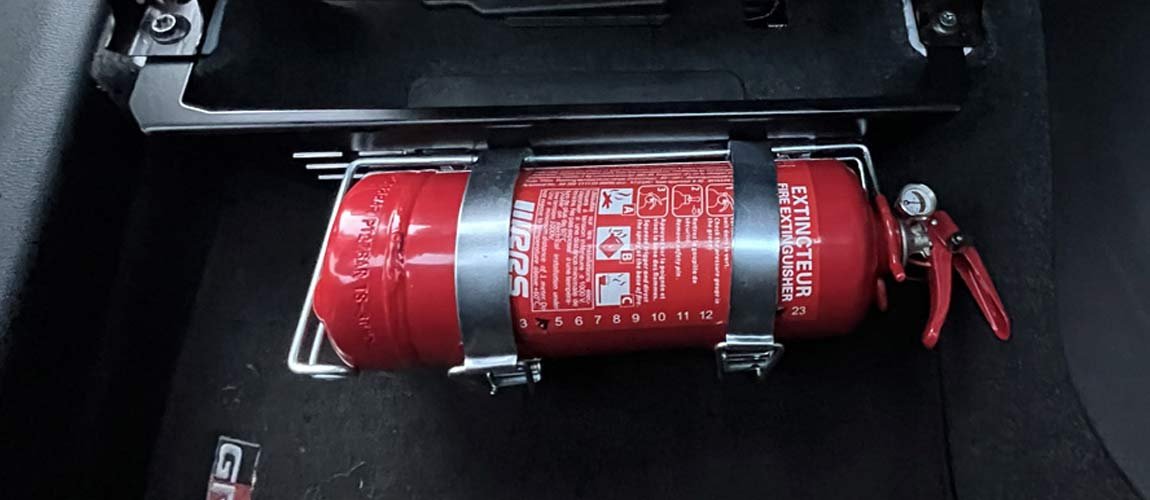
US fire departments respond to roughly 200,000 highway vehicle fires per year, and most start in the engine bay or electrical system, according to National Fire Protection Association (NFPA) and U.S. Fire Administration (USFA) data. A mounted extinguisher answers that risk at the incipient stage – the first moments of a small, just-started fire – after occupants are out of the vehicle. Car fires span three classes: Class B flammable liquids such as gasoline and brake fluid, Class C energized wiring, and Class A upholstery and trim that Federal Motor Vehicle Safety Standard (FMVSS) 302 regulates as an engineered fuel load.
Should you keep a fire extinguisher in your car? Yes – the vehicle fire risk is documented, and a small fire outgrows first attack within minutes. Do you need a fire extinguisher in your car for daily commuting alone? Exposure decides: commuting miles, aging fuel lines, and aftermarket electrical accessories all add ignition paths for an engine bay fire, from a fuel system leak reaching hot metal to an electrical system fire behind the dash. The class letters matter because every agent is certified against specific fire classes – the reason agent type is the first selection axis.
A home unit hangs on a wall-mount hook bracket in a climate-controlled hallway; a vehicle fire extinguisher rides vibration, cabin heat, and crash loads between uses – a different duty entirely. For track drivers and overlanders, the same fire classes apply at higher exposure: fuel handling in paddocks and trail miles far from the nearest fire station.
A car needs an extinguisher rated for Class B and Class C fires at minimum, which narrows the choice to three agent types: ABC dry powder, halocarbon clean agent, or carbon dioxide (CO2). ABC dry powder costs the least (roughly $25-40) and covers all three fire classes, while a clean agent costs more (roughly $75-160 at comparable size) and leaves nothing behind in the cabin. Inside an enclosed interior, the deciding criterion is what the agent leaves after discharge.
The ABC-versus-clean-agent decision is the one most buyers of a fire extinguisher for a car face; CO2 stays a niche third option. Water and foam units are unsuitable for a car: water conducts across live wiring and freezes in a winter cabin, and foam adds a Class A-B blanket without a Class C certification. Dry chemicals and clean agents instead interrupt the fire tetrahedron – heat, oxygen, fuel, and the chain reaction – without conducting electricity, and all three candidate agents ship in UL-listed automotive sizes.
The table compares the three types of fire extinguisher for a car – plus the budget BC variant – on the specifications that separate them: fire classes covered, cabin residue, and price tiers.
| Agent | Fire classes covered | Cabin residue | Price tier (2.5 lb class) |
|---|---|---|---|
| ABC dry powder (monoammonium phosphate) | A, B, C | Corrosive powder blanket | Roughly $25–40 |
| BC dry chemical (sodium bicarbonate) | B, C | Milder bicarbonate dust | Below comparable ABC units |
| Halocarbon clean agent (Halotron I, FE-36) | Commonly B, C; Class A at larger sizes | None — vaporizes on discharge | Roughly $75–160 and up |
| CO2 (carbon dioxide) gas | B, C | None — gas disperses | Sold from 5 lb up; hydrostatic servicing adds cost |
Across all four rows, residue and price trade against each other while the coverage letters stay on the nameplate – a trade the ABC, clean-agent, and CO2 profiles each settle differently.
Discharged ABC powder coats the cabin and engine bay in a fine monoammonium-phosphate blanket that corrodes aluminum, wiring, and control units when it is not removed quickly. On a light fire, cleanup and corrosion often exceed the fire damage itself – the main argument for paying the clean-agent premium on a car whose interior matters. The dense powder cloud also blocks vision during discharge in or near the cabin and burdens the lungs at close range.
Dry chemical residue spans a spectrum: ABC’s corrosive blanket at one end, BC’s milder bicarbonate dust in the middle, and nothing at all from agents sold as a no residue fire extinguisher or a fire extinguisher safe for electronics. Electronics corrosion is the hidden cost item – a dry chemical fire extinguisher for a car can add professional interior cleanup to the bill that a residue-free unit avoids.
A clean agent fire extinguisher is worth the premium when the cabin, wiring, or electronics are worth more than the roughly $50-120 price difference over ABC powder. A clean agent is a halocarbon that discharges as a rapidly vaporizing liquid stream and leaves no residue, no vision-blocking cloud, and no corrosion – the property behind every non toxic fire extinguisher label on the automotive shelf. Halotron I leads the family; successor chemistries such as Halotron BrX (2-BTP) and FE-36 extend it as the Montreal Protocol, the EPA Significant New Alternatives Policy (SNAP) program, and AIM Act phasedowns reshape the clean-agent shelf.
A halotron fire extinguisher for a car comes in sizes from compact 1.4 lb bottles through 5 lb Halotron units, so the premium scales with capacity. For collector cars and electronics-dense cabins – the specialty end of the market – the worth-it threshold arrives sooner, because original trim and control modules concentrate value inside the cabin the agent will touch.
No, a CO2 fire extinguisher is rarely the right car choice, even though it suppresses Class B and C fires without residue. The heavy steel cylinder, short throw, gaugeless weight-check servicing, 5-year hydrostatic test cycle, and oxygen displacement in a closed cabin all count against it. A CO2 extinguisher rides in a gaugeless high-pressure DOT-spec cylinder, so readiness is confirmed by weighing the unit rather than glancing at a gauge – one more service step a private driver rarely keeps.
CO2 suits workshops, service garages, and fleet depots better than a passenger footwell: open spaces disperse the gas safely, and trained staff work within its short throw. In a closed cabin, the same discharge displaces breathable oxygen where occupants sit – the confined-space discharge hazard that keeps CO2 off most car shortlists.
Purple-K makes sense when flammable-liquid knockdown is the priority: its potassium-bicarbonate charge delivers roughly double the Class B suppression per pound of sodium bicarbonate, which is why PK units dominate pit lanes and fuel-handling paddocks. It stays a BC-only dry chemical – no Class A trim coverage, and a residue that still lands in the cabin, milder than ABC’s.
No, aerosol formats work as backups, not as a car’s primary extinguisher. A condensed aerosol stick such as the Element E50 discharges for roughly 50 seconds, needs no gauge or servicing, and packs flat – but it carries no UL numerical rating, fits no standard band clamp, and scrutineer acceptance varies. The gaugeless stick offers a service-free shelf life – no recharge, hydrostatic test, or expiry date – which is unique among common car extinguisher formats, and the larger Element E100 extends the discharge time further.
Single-use spray cans, typically rated 2B:C (Fire Gone is the common example), throw short and hold seconds of agent – a sub-$20 glovebox supplement at most. Drivers weighing what kind of fire extinguisher a car needs sometimes start with these formats; the honest classification is micro-fire backup beside a rated unit, never a replacement for one. Cartridge-operated designs sit at the opposite pole as commercial hardware rebuilt after each use, and neither outlier fits a standard vehicle clamp – the stick requires its maker’s dedicated mount.
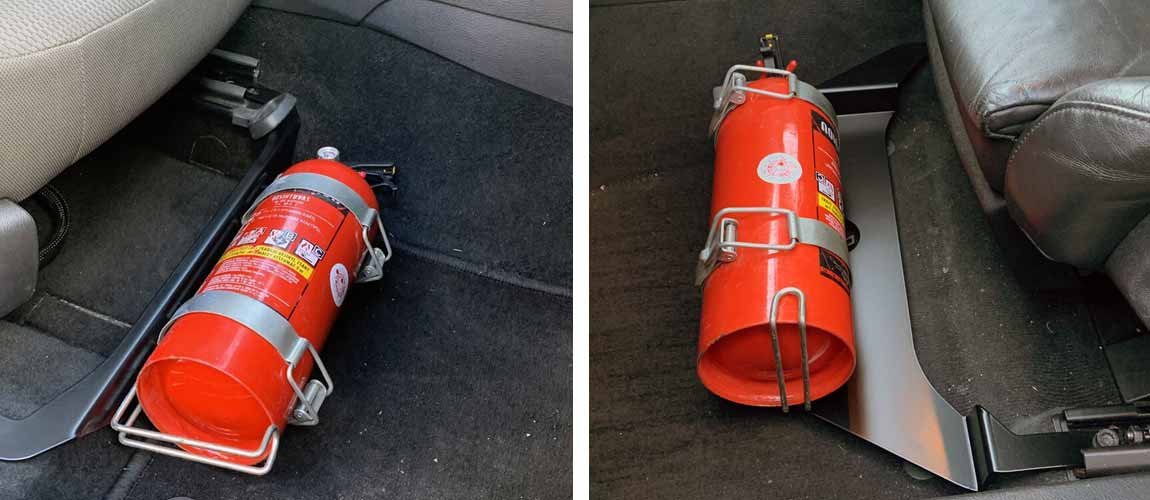
A 2.5 lb extinguisher is the standard size for a passenger car: enough agent for an incipient fire, compact enough to mount in the cabin, and the common minimum at motorsport tech inspection. Size is a physical decision as much as a capacity decision – a 2.5 lb unit weighs roughly 4.5 lb (2 kg) loaded and spans roughly 3.2-3.5 inches (81-89 mm) of cylinder diameter, the two numbers your bracket’s load rating and clamp range must accept. Capacity determines discharge time: roughly 8-15 seconds on 1-2.5 lb units, up to roughly 20 seconds at 5 lb.
The practical answer to “what size fire extinguisher do I need?” is the largest size or weight class your cabin and bracket accept – mount compatibility is part of the size decision, not an afterthought. Gross weight vs agent weight is the spec sheet’s first distinction: the label names the agent charge, while the bracket carries the loaded cylinder – valve, propellant, and steel included – at roughly double the labeled figure, the value a bracket’s load rating must restrain under crash deceleration.
Cylinder diameter decides clamp fit the same way: roughly 3.2-3.5 in on 2.5 lb units and roughly 4.25 in (108 mm) on 5 lb units, and the clamp’s diameter range must close around that outside diameter. Overall height is measured valve-inclusive and must clear the seat frame, footwell trim, and slider travel at every seat position. The plastic clip or thin strap bracket packed in many retail boxes is shelf hardware, not vehicle restraint – crash retention comes from a rigid, load-rated mount matched to those numbers.
Discharge range runs typically 6-18 ft (1.8-5.5 m), rising with size, and how big a fire extinguisher your car can carry is set by the mount as much as by the shelf. The best size fire extinguisher for a car therefore reads the same for a commuter, a track entrant, and an overlander alike: the class whose gross weight, cylinder diameter, and overall height all clear the bracket’s ratings, with the deciding numbers compared class by class in the car fire extinguisher size chart.
No, a 1 lb fire extinguisher is not enough for most cars: it empties in roughly 8 seconds and carries marginal agent for anything beyond a just-started micro-fire. A small fire extinguisher for a car – retail listings also say compact, mini, or portable – earns its place in tight cockpits and weight-counting builds where a 2.5 lb cylinder does not physically fit. The best small fire extinguisher for a car is the largest one its cabin accepts – step up when space allows.
A 1 lb extinguisher trades capacity for envelope: less diameter for the clamp, less gross weight for the mount, and a briefer discharge window than any larger class. Weight-sensitive builds accept that trade knowingly; commuters rarely need to.
The 2.5 lb class balances every constraint a car imposes, and there are five: roughly 10 seconds of discharge, a 1-A:10-B:C rating on typical ABC units, a cylinder near 3.2-3.5 inches that standard vehicle clamps grip, a loaded weight near 4.5 lb that seat-rail brackets are rated to restrain, and the capacity motorsport rulebooks commonly set as the handheld minimum. Tight two-seaters – a Mazda MX-5 Miata cabin is the archetype – cap the cylinder envelope at exactly this class.
A 2.5 lb fire extinguisher is the standard answer rather than a compromise: below it, capacity turns marginal; above it, diameter and gross weight outgrow standard cabin mounts. That constraint balance, not marketing, is why the class anchors both the daily-driver and the track shortlists.
Step up to a 5 lb fire extinguisher when the vehicle has the space and payload to carry it – trucks, overland rigs, and tow vehicles are the natural platforms. The 5 lb class roughly doubles the agent on board, usually adds a flexible discharge hose for aiming into engine bays and wheel arches, and stretches discharge time toward 20 seconds. It also roughly doubles what the mount must restrain: about 10 lb (4.5 kg) loaded on a roughly 4.25-inch (108 mm) cylinder.
A 5 lb extinguisher usually carries a hose, and a hose outperforms a fixed nozzle for reach and aim at the cost of bulk and a taller mounting envelope. Street prices for the class stay moderate at roughly $60-90 for 5 lb ABC units, so the cost of stepping up sits in mounting space and bracket rating more than in price. Overlanding scales the argument: a payload-rich truck such as a Toyota Tacoma carries the doubled weight without approaching its payload limit, and self-reliance far from fire response rewards the extra seconds – once the bracket’s load rating is confirmed against the doubled loaded weight.
The size chart below compares the three car fire extinguisher classes by agent weight, loaded weight, cylinder diameter, typical UL rating, and discharge time – the five numbers that decide both suppression capacity and mount fit. Fire extinguisher dimensions read against hardware: check the diameter and loaded-weight columns against your bracket’s clamp range and load rating before buying, because the spec sheet, not the label name, is what a clamp closes around.
| Class | Agent weight | Loaded weight (typical) | Cylinder diameter (typical) | Typical UL rating | Discharge time |
|---|---|---|---|---|---|
| Compact | 1–1.4 lb (0.45–0.64 kg) | Roughly 2–3 lb (0.9–1.4 kg) | Roughly 3 in (76 mm) | Commonly 5-B:C; some carry 1-A:10-B:C | Roughly 8 seconds |
| Standard | 2.5 lb (1.1 kg) | Roughly 4.5 lb (2 kg) | Roughly 3.2–3.5 in (81–89 mm) | Commonly 1-A:10-B:C (ABC) | Roughly 10–15 seconds |
| Heavy | 5 lb (2.3 kg) | Roughly 10 lb (4.5 kg) | Roughly 4.25 in (108 mm) | Commonly 2-A:10-B:C or higher | Up to roughly 20 seconds |
Overall cylinder height completes the cylinder dimensions worth pulling from the spec sheet – measured valve-inclusive, it defines the mounting envelope against seat frames and slider travel. Across fire extinguisher sizes, cylinder material shifts the loaded weight inside each class (aluminum trims it, steel costs less), and stored-pressure units commonly tolerate vertical or horizontal mounting orientation – the manufacturer’s label confirms which.
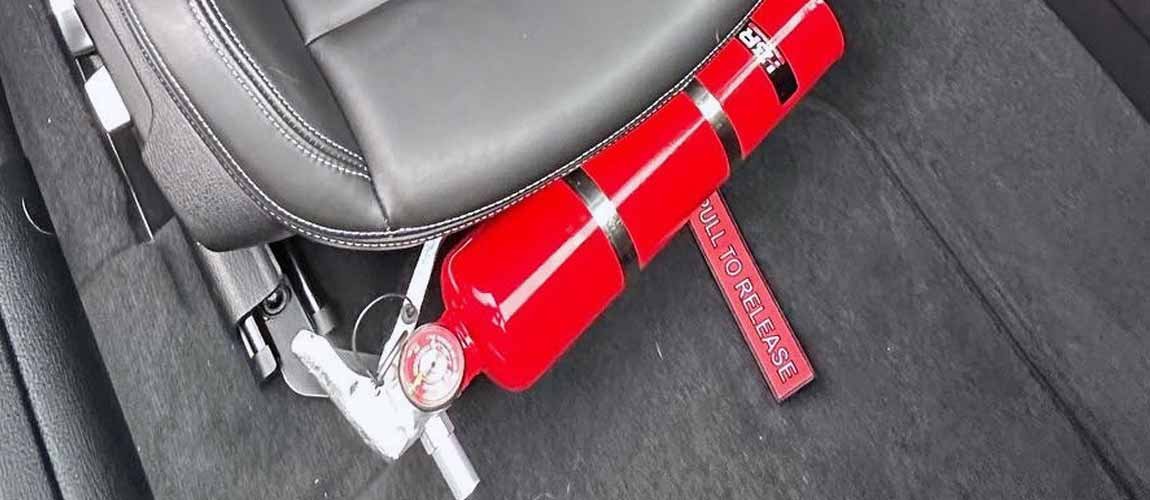
A vehicle fire extinguisher needs a UL-listed rating of at least 5-B:C – the federal floor for commercial power units – and 1-A:10-B:C is the practical passenger-car baseline because cabins add Class A upholstery and trim. The 5-B:C floor comes from the Federal Motor Carrier Safety Administration (FMCSA); the alphanumeric rating on the nameplate is a tested result, not marketing. UL 711 fire tests generate the numerals, and UL 299, UL 2129, and UL 154 list dry chemical, halocarbon, and CO2 units respectively – the certification triad behind most automotive fire extinguisher nameplates. A unit with no listing at all fails inspections before any other specification is read.
For the buyer, the rating works as a verification tool: match the nameplate against the fire classes a car presents, and treat a missing or invented listing as disqualifying. Roadside and tech inspectors read the same nameplate – commercial drivers against the federal floor, scrutineers against their rulebook minimums – which makes the UL fire rating the one specification every extinguisher for a car shares, whatever the use case, checked before any bracket question begins.
Read a UL rating left to right: the number before A states Class A capability in water-equivalents (1-A equals roughly 1.25 gallons or 4.7 liters), the number before B states the square feet of flammable-liquid fire the unit extinguished in UL 711 heptane pan tests (10-B covers roughly 10 sq ft or 0.9 m²), and the letter C – which never carries a numeral – certifies a non-conductive agent for live electrical fires. On a 1-A:10-B:C nameplate all three read at once; a 5-B:C label skips the Class A test – the difference between the ABC and B:C rating forms.
Verify any claimed listing in the public UL Product iQ directory: uncertified import extinguishers with invented ratings fail motorsport tech, FMCSA checks, and insurance scrutiny. Drivers asking what class of fire extinguisher a car needs are decoding the same UL label anatomy – the letters name the fire classes, the numerals scale the tested capability. European-market units carry EN 3 markings and Canadian units carry ULC listings – one system per market, the same decode logic.
FMCSA 49 CFR 393.95 requires commercial power units to carry a securely mounted, UL-listed extinguisher rated at least 5-B:C – or 10-B:C when the vehicle is hazmat-placarded. “DOT approved” on a consumer label means something narrower: the U.S. Department of Transportation (DOT) and its Pipeline and Hazardous Materials Safety Administration (PHMSA) certify the cylinder as a pressure vessel, not the carriage of the unit. The US does not require private passenger cars to carry an extinguisher, though several countries do.
Roadside inspectors verify presence, rating, and securement on a fire extinguisher for a semi truck or a work pickup truck; a loose unit counts against the carrier even when its 5-B:C rating clears the floor. RV, marine, and motorcycle carriage rules run on separate rulebooks – the U.S. Coast Guard (USCG) governs boats, not passenger cars – and belong to those platforms’ own guides.
Motorsport tech inspection commonly requires a rated handheld of 2.5 lb minimum, a pressure gauge reading in the green, in-date service, and a metal, positively latching bracket – plastic clip mounts are rejected. Wording varies by sanctioning body, class, and season: the Sports Car Club of America (SCCA) General Competition Rules currently set the handheld floor near 2 lb with a metal quick-release bracket, National Auto Sport Association (NASA) rulebook wording commonly lands at 2.5 lb, and National Hot Rod Association (NHRA) classes write their own line – so read the current rulebook before a race car fire extinguisher goes in.
The scrutineer inspects the extinguisher and its mounting as one system, which is why the bracket is part of passing tech. Plumbed SFI- and FIA-specification suppression systems are a separate competition category outside this guide’s scope.
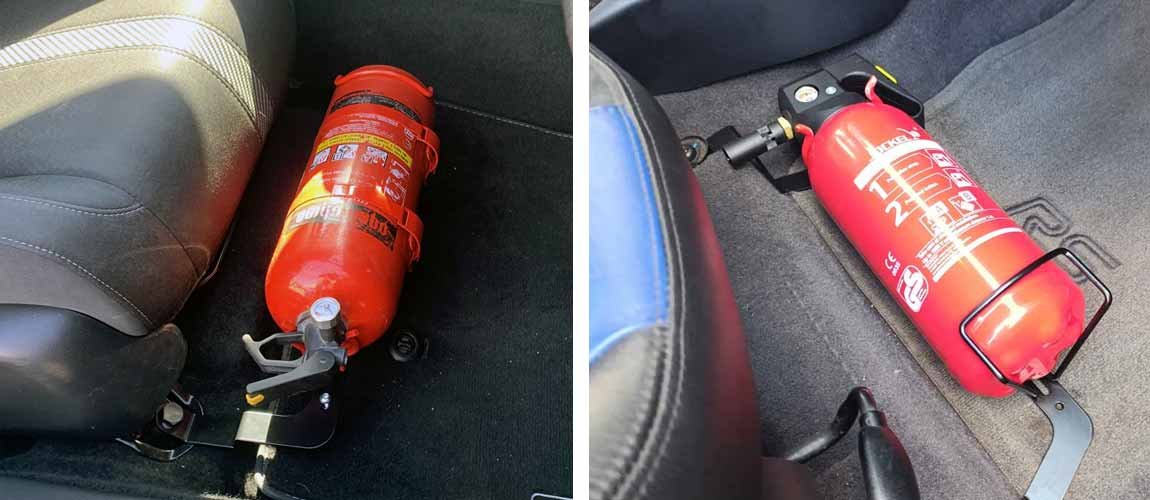
A disposable car fire extinguisher lasts roughly 12 years from its stamped manufacture date; a rechargeable metal-valve unit continues indefinitely under service – monthly gauge-and-pin checks, 6-year internal maintenance, and 12-year hydrostatic tests (5-year for CO2) under NFPA 10, the standard fire codes reference for portable extinguishers. A lapsed service date fails tech inspection regardless of the unit’s condition, and any discharge, however brief, requires a professional recharge – partial use leaves a unit that reads full but fails. Vehicle duty adds two wear factors of its own to that service life: cabin heat-soak stresses valve seals, and road vibration exposure can compact dry powder, which makes the monthly gauge glance worth keeping.
NFPA 10 intervals for a stored-pressure unit break down as follows:
| Check | Interval (NFPA 10) | What it covers |
|---|---|---|
| Owner visual check | Monthly | Gauge in the green, pull pin and tamper seal intact, no cylinder corrosion |
| Internal maintenance | Every 6 years (rechargeable dry chemical) | Agent condition and valve internals, serviced professionally |
| Hydrostatic test | Every 12 years (every 5 for CO2) | Cylinder pressure integrity |
| Replacement (disposables) | By expiry — roughly 12 years from the date stamp | Whole-unit renewal |
The 10-second owner check is the gauge: a needle in the green means the stored nitrogen propellant still holds working pressure. Keep the car extinguisher’s inspection tag or service record with the vehicle for tech and roadside checks, and dispose of expired units through a household hazardous-waste program or an extinguisher service company.
Buy a rechargeable, all-metal-valve extinguisher when the budget allows: it can be professionally refilled after any use, survives heat and impact better, and withstands the scrutiny that plastic-valve disposables attract. Recall history drew the build-quality line in practice: in 2017 the Consumer Product Safety Commission (CPSC) recalled roughly 37.8 million plastic-handle Kidde units across 134 models – one of the largest US consumer-product recalls – after failures that included a 2014 death when a unit would not discharge during a car fire. A metal valve head also marks the units worth servicing: National Association of Fire Equipment Distributors (NAFED)-affiliated dealers recharge, hydrostatic-test, and tag serviceable units nationwide.
In the rechargeable vs disposable decision, lifetime cost favors the rechargeable across service cycles and refills, while a disposable ends its service at first use or expiry, whichever comes first.
Yes, it is safe to keep a listed fire extinguisher in a hot car: units carry an operating temperature range of typically -40°F to +120°F (-40°C to +49°C), and listed cylinders carry engineering margins above that band. Parked interiors can exceed roughly 140°F (60°C) in summer sun – near or past the listed limit – which stresses valve seals and can accelerate silent propellant leak-down rather than cause an explosion. The monthly gauge check exists to catch that loss.
The stored-pressure design works in the extinguisher’s favor: a sealed cylinder with no exposed mechanism, engineered for pressure swings. Whether you can keep a fire extinguisher in your car through summer is therefore a maintenance question, not a hazard question, and cabin heat exposure answers whether a fire extinguisher can explode in a hot car the same way: slow leak-down, not detonation, is the realistic failure mode for a listed unit.
A handheld extinguisher handles incipient-stage fires only – small, just-started fires in their first moments. The sequence comes first: pull over, shut off the engine, get every occupant out, and then decide whether the fire is still small enough to attack from the unit’s listed range. A fire that has outgrown first attack means retreat and a call to the fire service; a vehicle fire can escalate to an untenable cabin within minutes.
Two boundaries complete the honest picture: a knocked-down car fire can re-ignite from hot metal and residual fuel vapor, so distance holds until the fire service clears the vehicle, and Class D metal fires belong to specialist powders no car unit carries. The PASS sequence – pull, aim, squeeze, sweep – belongs to hands-on extinguisher training, which a local fire department or safety course teaches better than any label.
No, no handheld extinguisher can put out an EV traction-pack fire in thermal runaway – the self-propagating failure of lithium-ion cells generates its own heat and oxygen and defeats every portable agent. An onboard unit still earns its place in an electric car: it covers the 12-volt electrical system and interior materials, and it can slow spread while occupants exit. That split – pack fire no, everything else yes – is the honest answer behind every fire extinguisher for an electric car search.
Specialist AVD (aqueous vermiculite dispersion) handhelds such as the Firechief Lith-Ex claim cell-level lithium fires only – device packs and e-bike cells, never automotive traction packs – so a lithium fire extinguisher label deserves a careful read. The best fire extinguisher for an electric car, like any fire extinguisher for an EV, covers the same Class B and C risks as other car units, and a vehicle fire blanket adds a spread-delay layer some EV owners carry alongside.
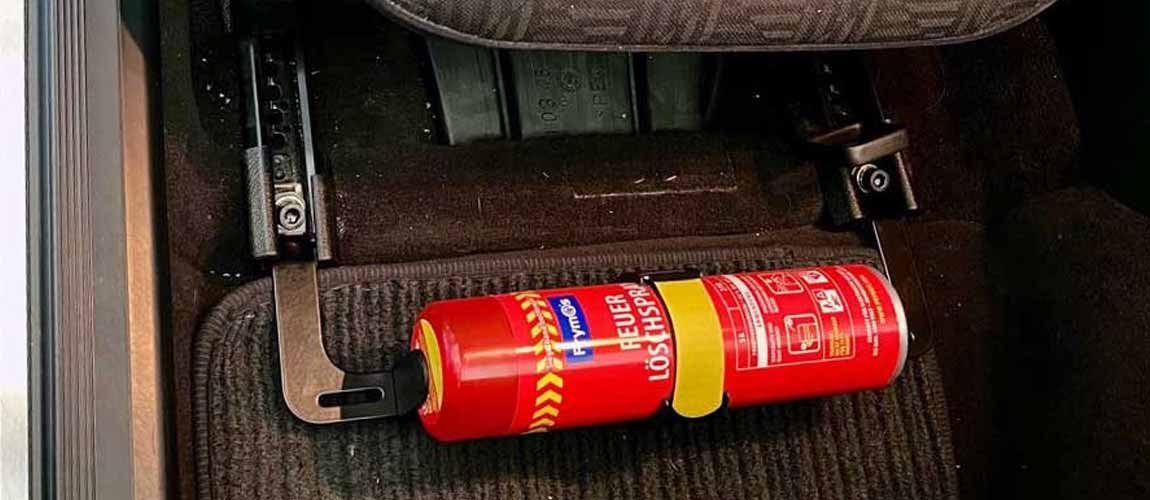
The best fire extinguisher for most cars is a 2.5 lb rechargeable unit – ABC dry powder if price leads the decision, clean agent if the interior leads – with a UL listing you can verify and a cylinder diameter your mount’s clamp accepts. Every pick is spec-led, listing agent, UL rating, loaded weight, and cylinder diameter, because those four numbers decide fit and function, not brand marketing. Independent evidence shapes the shortlist: the Project Farm channel’s recorded head-to-head discharge testing across major brands (Amerex, First Alert, and Ansul among them) and CPSC recall history.
What is the best fire extinguisher for a car splits by duty, so four use cases – daily driver, track days, trucks with off-road rigs, and classic cars – resolve it separately; which fire extinguisher is best for your car depends on the axis that leads: price, interior, capacity, or rulebook. A good fire extinguisher for a car earns its recommendation on the nameplate, and the most recommended fire extinguisher for a car is the one whose spec sheet matches the bracket already in the cabin. The best fire extinguisher for a car fire is the auto fire extinguisher already mounted within reach – the reason a rated unit anchors a vehicle emergency kit beside a first-aid kit, a warning triangle, and a jump pack. Warranty coverage commonly runs longer on all-metal rechargeable lines than on plastic-valve disposables – one more line worth reading on the spec sheet.
A daily driver is best served by a 2.5 lb ABC unit such as the Amerex B417T – roughly 4.5 lb loaded, a roughly 3.2-3.5 inch cylinder, 1-A:10-B:C, rechargeable metal valve – when budget leads. When the interior and electronics lead, the best car fire extinguisher becomes the Amerex B386T, a halotron fire extinguisher in 2.5 lb form that trades a lower listed rating – 2-B:C against the ABC twin’s 1-A:10-B:C – for residue-free discharge; pull its exact diameter and weight from the current Amerex datasheet and check them against your clamp before ordering. Budget disposables such as the First Alert AUTO5 (5-B:C, sodium bicarbonate) work as entry units – their bundled plastic clip brackets do not.
Track days call for a rated handheld of commonly 2.5 lb minimum in a metal, positively latching mount – the package scrutineers expect at tech, with rulebook wording varying by sanctioning body and season. Purple-K delivers the fastest Class B knockdown per pound for fuel-heavy paddocks; a 2.5 lb clean agent unit keeps a street-driven track car’s interior intact; and the best automotive fire extinguisher for a race car build is whichever of the two its rulebook and fire risk favor. Track-day extinguisher selection stays a handheld decision until a build steps up to wheel-to-wheel competition and plumbed systems.
Weight-counting builds choose smaller, cleaner formats rather than skipping capacity – a compact or mini unit where the rulebook allows it – because a racing fire extinguisher or a track day fire extinguisher left in the garage saves no car. The weight penalty of a mounted 2.5 lb unit is its roughly 4.5 lb loaded mass, a fixed cost most track/race builds absorb.
commercial power units must meet. Overland builds far from fire response add capacity and vibration-resistant mounting; a Jeep Wrangler or a Toyota Tacoma carries the size well inside its payload rating. Confirm the bracket’s load rating against the doubled loaded weight before stepping up.
A truck fire extinguisher shortlist follows the platform: the best fire extinguisher for a Jeep on trails doubles as an off road or overland fire extinguisher, and the best fire extinguisher for a truck in commercial service is the one that clears the federal floor with margin. Vibration exposure defines the duty, so pair the unit with purpose-built truck fire extinguisher mounts rated for the doubled load, and consider two-unit redundancy – cab plus bed or trailer – on rigs working far from help. On work fleets, the best vehicle fire extinguisher is the compliant one: rating, securement, and service date all current.
Amerex B402-type – ABC dry powder | commonly 2-A:10-B:C or higher | roughly 10 lb (4.5 kg) loaded | roughly 4.25 in (108 mm) cylinder | flexible discharge hose
A classic car is best served by a clean agent extinguisher: residue-free discharge protects original upholstery, paint, and period wiring that ABC powder would corrode, while carbureted fuel systems raise the odds of a Class B carburetor backfire fire. A classic car fire extinguisher is a preservation decision – the no-residue route costs more per pound and repays it the first time it discharges near original trim. Legacy halon 1211 units still ride in collector cars: refillable from recycled stocks, never sold new since the Montreal Protocol production ban, and serviced legally by specialist shops.
Retire vintage soda-acid and carbon-tetrachloride display pieces from active duty – obsolete extinguisher types belong on display, not in service. A chrome fire extinguisher dresses a show-car engine bay, and the finish changes nothing on the nameplate. The best fire extinguisher for a classic car pairs with period-sympathetic hardware: quick-release extinguisher mounts for classic cars hold the bottle firm without marring original metal, completing the best auto fire extinguisher package for a garaged collectible.
Run three checks before you buy: the cylinder diameter must land inside the bracket clamp’s range, the loaded weight must sit under the bracket’s load rating, and the overall height must clear the seat frame and slider travel. A loose cylinder becomes a several-pound steel projectile in a crash, and the thin clip brackets bundled in retail boxes are shelf hardware, not vehicle restraint – which is why the mount belongs inside the purchase decision for an automobile fire extinguisher, not after it. Factory precedent agrees: Porsche sells a compact handheld extinguisher with model-specific mounting hardware through its Tequipment accessory program. The fastest cross-check runs per vehicle – pick the bracket for your car model and read its clamp range and load rating against the extinguisher’s spec sheet. The no-drill vs drilled mounting decision then settles how that bracket meets the car.
Placement comes next: where the unit rides in the cabin is a question of fire extinguisher mounting positions, weighing reach, passenger clearance, and crash exposure. Installation follows placement, and installing the bracket without drilling covers the seat-rail method that leaves the floor intact. Roll-bar clamp mounts follow the same placement logic on caged cars, and every route ends at the same hardware standard: rigid brackets – compact-cabin through heavy-duty vehicle brackets – in 3 mm laser-cut steel with quick-release band clamps, retention-tested against crash loads.
Choosing a fire extinguisher for your car resolves to type, size, and rating – and the bracket that holds it. Match the agent to your cabin, the capacity class to your space and payload, and the UL rating to your inspections, then give the chosen unit per-vehicle fitment instead of a loose footwell. And remember, F4Fabrication builds no-drill, vehicle-specific fire extinguisher mounts per make and model, so the extinguisher you selected on those three axes stays restrained where you mounted it – ready for the incipient-stage fire it was chosen for.