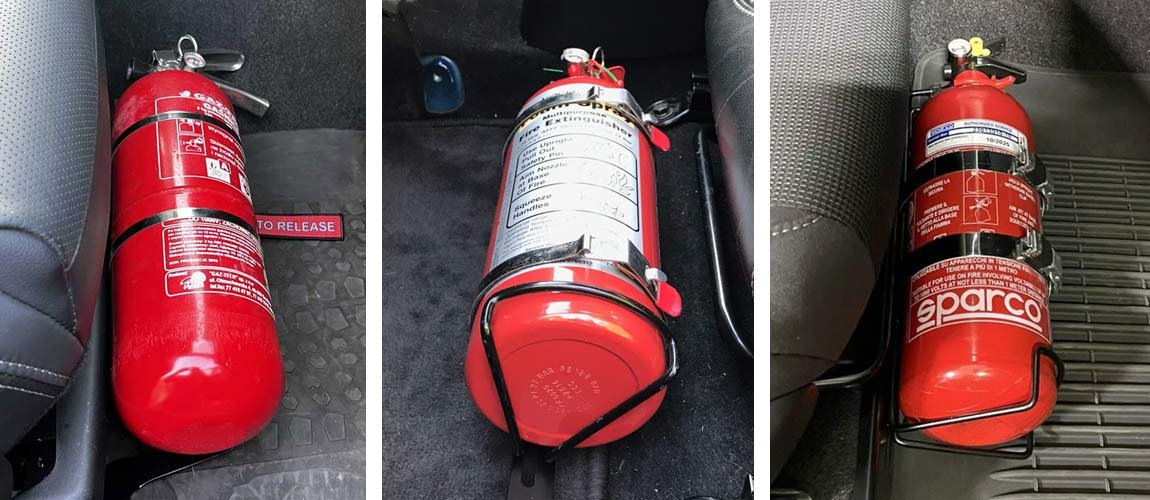
The fire extinguisher you need at a track day is the one your event’s rulebook accepts, not the one a consumer review rates highest. The Sports Car Club of America (SCCA) sets a 2 lb floor for a race car fire extinguisher rated 10 B:C or 1A:10B:C, and the Fédération Internationale de l’Automobile (FIA) sets 2.4 litres of AFFF or 2.0 kg of gas or powder in Appendix J Article 253.7. A rule-accepted handheld fire extinguisher also shows a charge indicator, carries an in-date certification label, and sits in a metal quick-release bracket within reach of a seated, belted driver holding the steering wheel. At a High Performance Driver Education (HPDE) or open-lapping day, one compliant race extinguisher satisfies the organiser, and wheel-to-wheel classes escalate from there. Choosing a track day fire extinguisher starts with the document, and each acceptance condition resolves in the order a scrutineer checks it.
Yes — every organisation that runs cars on a circuit requires a fire extinguisher, and the force of that requirement changes with the event. Motorsport fire extinguisher requirements divide along a single line: whether the sanctioning body treats the unit as a recommendation or as a condition of entry. An HPDE or open-lapping entrant complies with a rule-legal racing fire extinguisher alone, outside the plumbed-system mandates, and many organisers word that as strongly recommended rather than mandatory.
Club racing removes the choice. SCCA requires an SFI- or FIA-approved fire system in any car first registered after 1 January 2009, which turns a registration date into a purchase decision for a car that was never modified for competition. A first-time entrant and a logbooked club racer are therefore reading two different documents about the same object, and the object does not change between them. Two positions cover almost every entry:
The distance between those two positions is why one answer cannot serve every reader, and why the first question is which document binds your entry rather than which product wins a comparison.
The rulebook governing a given entry is one of three documents: the SCCA General Competition Rules (GCR), the NASA Club Codes & Regulations §15.1 and §15.2, or FIA Appendix J Article 253 applied through a national sporting authority (ASN). NASA here is the National Auto Sport Association, the road-racing sanctioning body, not the space agency that shares the acronym. SCCA fire extinguisher requirements sit inside the SCCA GCR, which names the minimum agent weights, the acceptable agents and the UL rating string, and requires the bracket to be metal and quick-release.
NASA fire extinguisher requirements split the subject in two. NASA CCR §15.1 covers the handheld extinguisher and §15.2 covers the onboard fire system, and the handheld clause adds that mounting hardware must be nuts and bolts rather than sheet-metal screws. FIA Appendix J Article 253 sits above both outside the United States and reaches a local event through the ASN that administers motorsport in that country. A verifier holding a European unit and a US entry form is reading both at once. Read the one that binds you, because the three documents do not agree on capacity, agent or units of measurement.
The organiser who decides which rulebook applies is as often a marque club — Porsche Club of America, BMW Car Club of America — or an SCCA Track Night in America evening as it is SCCA or NASA club racing. Those organisers publish their own minimum standards, and at a US track day that supplementary document is often the only one that matters on the day. An HPDE fire extinguisher bought against a national rulebook can still miss a club standard written for its own paddock.
Grassroots endurance series — ChampCar Endurance Series and 24 Hours of Lemons — set fire-equipment requirements above the HPDE handheld baseline at budget level. Autocross sits at the other end of the same spread, with the lightest requirement of any competition format, while time trial and wheel-to-wheel racing move progressively toward the club racing fire extinguisher standard. A builder preparing one car for several formats — track days, time trial and autocross — has to satisfy the strictest of them, not the average. Check the supplementary regulations for the specific event you entered, because a club’s standard can be stricter than the national rulebook it borrows from.
A motorsport fire extinguisher proves its specification through a physical mark, not through marketing copy: an SFI 17.1 tag, an FIA homologation number printed on a current FIA Technical List, or a UL or EN 3 listing on the nameplate. A UL listing and an EN 3 listing do the same job for the portable unit, printed on the nameplate rather than hung from the neck of the bottle. A scrutineer reads that mark and nothing else, so an unlabelled unit fails at the tech table regardless of how well it performs. The certification label is the object under inspection, and the bottle behind it is only the thing the label describes.
“Approved” is a certification relation with a named grantor behind it, not a quality adjective. An SFI-approved fire extinguisher means the SFI Foundation granted approval against a written specification on a dated tag; an FIA-approved fire extinguisher means the FIA published that unit’s homologation against a numbered standard. Homologation is therefore a registry fact you can look up rather than a claim a seller makes. A first-time entrant who has never read a tag and a verifier cross-checking a quoted part number both resolve acceptance the same way. Three questions settle it:
SFI Specification 17.1 certifies a racing fire suppression system’s discharge performance and its service currency, and the SFI Foundation brought the current specification into effect on 26 June 2020. A system carrying the tag has been qualified to discharge at least 95% of its agent and extinguish the test fire inside the specification’s time limit — 10 seconds for a rear-engine car, 20 seconds for a front-engine car. Those two figures are performance thresholds the SFI Foundation tests against, not manufacturer estimates.
SFI Specification 17.1 also requires recertification two years from filling, carried on a dated label on the bottle. That two-year clock is the ownership fact most buyers moving from road equipment get wrong, because road use imposes no equivalent interval and no one at a service counter volunteers it. A club racer who buys a certified system mid-season inherits whatever remains of the previous owner’s clock. Cite the edition year whenever you quote the specification to a scrutineer, because a tag proves specification rather than quality.
FIA Standard 8865-2015 is the current specification for plumbed-in and hand-held fire extinguisher systems, and systems homologated to it are published on FIA Technical List n°52. FIA Technical List n°16 lists systems homologated to the FIA’s legacy 1999 plumbed-in standard — not systems homologated to 8865-2015. The widely repeated phrase “FIA 8865, Technical List 16” therefore names two documents that do not belong together. Anyone checking FIA fire extinguisher regulations against a catalogue entry is checking two different registries when that pairing is copied forward.
FIA Standard 8876-2022 has since been published on FIA Technical List n°97, succeeding the 8865-2015 generation. A homologation is valid only against the standard its list publishes, which is why the list number travels with the standard rather than with the brand. Three rows carry the whole registry question — the standard, the list that publishes it, and its present status:
| FIA standard | Published on | Status |
|---|---|---|
| Legacy 1999 plumbed-in standard | FIA Technical List n°16 | Superseded generation |
| FIA Standard 8865-2015 | FIA Technical List n°52 | Current for plumbed-in and hand-held systems |
| FIA Standard 8876-2022 | FIA Technical List n°97 | Succeeds the 8865-2015 generation |
Check which standard your series still runs before you buy, because a homologation citing a superseded standard eventually stops being accepted whatever the bottle’s condition or service date. A club racer entering one FIA-permit event a year and a verifier importing a unit face the same registry question. The list number, not the brand, is what a scrutineer can verify.
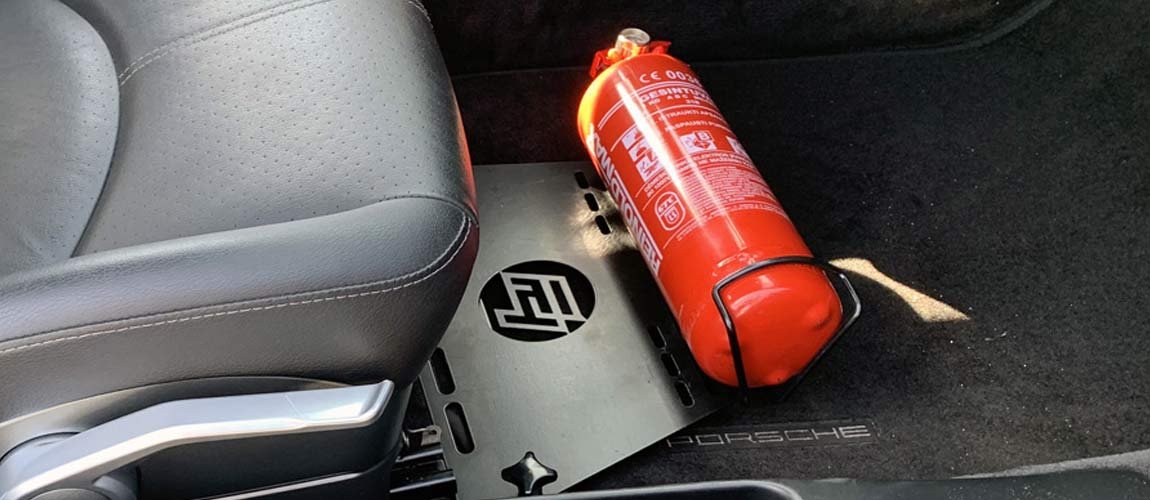
A buyer outside North America reads compliance from an EN 3 marking where a US-written rulebook says “UL-rated”. EN 3 is the European portable-extinguisher standard, and it assigns the same style of letter-and-number rating class that a UL listing does, printed in the same place on the nameplate. The two marks are jurisdictional counterparts rather than interchangeable certifications, so a scrutineer reading one will not substitute the other.
A German entrant running under DMSB regulations, or a UK entrant under Motorsport UK, is reading FIA-derived requirements through a national sporting authority rather than an SCCA clause. For those entries the mark to look for is the FIA homologation, with the EN 3 listing underneath it as the portable-extinguisher rating. A US club racer shipping a car to a European event inverts the same problem. Bring the mark that matches the rulebook you entered under, not the one your local retailer stocks.
A cockpit-mounted race handheld has a rated agent capacity floor of 2 lb under SCCA, or 2.4 litres of AFFF or 2.0 kg of gas or powder under FIA Appendix J Article 253.7. SCCA applies its 2 lb floor to Halon 1301, Halon 1211, FE-36 and dry chemical alike, so the minimum agent charge weight does not move with the chemistry you choose. FIA specifies plumbed systems separately at 2.25 kg and 3.0 kg, which is a different equipment class rather than a larger version of the same one. Sizing a fire extinguisher for race car use therefore means reading one number out of one document:
| Rule set | Minimum for a cockpit handheld | Plumbed system sizes |
|---|---|---|
| SCCA | 2 lb of a named agent at a rated UL value | Specified as an SFI- or FIA-approved system |
| FIA Appendix J Article 253.7 | 2.4 litres of AFFF, or 2.0 kg of gas or powder | 2.25 kg and 3.0 kg |
An FIA-regulated paddock standardises on the 2.4 litre AFFF handheld, and an SCCA paddock standardises on 2 lb dry chemical. Anyone crossing between the two rule sets needs both numbers, because the two figures are never averaged into one. A builder packaging a bottle around a cage and a first-time entrant reading a product page are both better served by the exact floor than by a rounded conversion. Buy the unit that clears the floor written in the document your entry runs under.
The 5 lb and 10 lb sizes buyers ask about belong to trucks, tow rigs and paddock stands, not to a cockpit-mounted race handheld. A 5 lb cylinder is wider and taller than the clamp on most cockpit brackets, and it adds mass high in a car that is measured for class weight. It exceeds every handheld floor the rulebooks actually publish. Nothing in a club rulebook rewards the extra three pounds once the floor is cleared.
The 10 lb figure that circulates in track-day threads comes from plumbed-system charge weights and from commercial-vehicle carriage rules, and both govern different equipment on different vehicles. A race car extinguisher is sized by the space between a seat rail and a cage, and by the number a scrutineer reads off a document. Buy to the rulebook floor and to the space your cockpit actually has, then keep the larger unit in the trailer where it does useful work on a fuel spill or a paddock fire nobody is strapped into.
Rated agent capacity converts into a discharge time of roughly eight to fourteen seconds in a race car fire extinguisher, which is what the size question buys. Those seconds are spent buying an exit, not fighting a fire: a cockpit unit knocks down flame long enough for a belted driver to release the harness, climb out and clear the car before a trackside fire marshal arrives with far larger capacity. Reignition is the reason quantity still matters, because a unit that empties before the fuel source is cut leaves the fire to restart on the same hot surface.
Romain Grosjean’s 2020 Bahrain Grand Prix fire measured survivable exposure in seconds, not minutes, with layered protection buying the escape time. A driver’s own equipment is the first layer of that protection and the shortest-lived one. A first-time entrant tends to over-estimate what a handheld can hold back; a builder specifying a dual-purpose car tends to under-estimate how long extraction takes with a harness, a window net and a wheel fitted. Plan the seconds around driver extraction rather than around suppression, and treat the marshal’s arrival as the point the arithmetic changes.
A track car catches fire because sustained load puts pressurised fluid and incandescent metal within inches of each other for a whole session. Road driving never holds that condition long enough to matter; a twenty-minute session does. A racecar fire is therefore a predictable consequence of the operating envelope rather than an accident of bad luck, and the fire triangle it completes is fuel, heat and oxygen in a bay that supplies all three.
A track car fire presents Class B flammable-liquid risk and Class C energised-electrical risk, with Class A trim behind them, which is what decides the letters you need on the nameplate of a track fire extinguisher. The two ignition paths that account for most paddock fire stories are a failed fluid line and a heat-soaked exhaust component, and both are conditions a driver can inspect before the session rather than discover during it. A builder reads that as a maintenance list, while a first-time entrant reads it as the reason the tech sheet exists. A fire that starts at a pressurised fluid line and finishes on a hot exhaust component is the exact event the agent clauses and capacity floors were written against.
SCCA quotes the rating string 10 B:C, or 1A:10B:C for a multipurpose unit, and that string is what an inspector reads off the label. The letters in a B:C fire class rating name the fire classes the unit was tested against under UL 711 — B for flammable liquids such as race fuel, oil and brake fluid, C for energised electrical circuits, A for ordinary combustibles such as trim, carpet and upholstery. The number in front of B states the measured flammable-liquid capability, not a marketing figure. The three classes a track car presents map onto that string directly:
| Class | What burns | Where it appears on a track car |
|---|---|---|
| A | Ordinary combustibles | Trim, carpet, upholstery, sound deadening |
| B | Flammable liquids | Race fuel, engine oil, brake fluid, methanol |
| C | Energised electrical | Looms, alternator, battery cabling |
One fire class sits outside that string. A Class D fire — burning magnesium in a wheel, a bellhousing or an older crankcase — defeats every handheld agent a club rulebook permits, and it reacts violently with water-based agents rather than being smothered by them. A verifier reading a nameplate and a club racer reading the GCR both need that exception stated plainly, because no rating string on the market covers it.
A braided AN oil cooler line starts a track fire by chafing, failing, and spraying pressurised oil onto hot exhaust — three stages, each separately preventable at the point where the line crosses a bracket, a subframe or a bulkhead. AN here is the fitting standard the hose end is built to, not a brand, and the failure sits in the routing rather than in the fitting itself. A line that has moved half an inch over a season is already at stage one.
A turbocharger ignites leaked fluids by glowing under sustained load and retaining heat after shutdown, which is why a forced-induction track car sits at the top of the fire-risk distribution and why the risk does not end when the session does. Both paths share one signature: a fluid under pressure meeting a surface hot enough to ignite it. A builder inspects routing, clamps and heat shielding before the session; an entrant renting seat time inherits whatever the last owner did. Inspect what you can reach, then carry the unit for the failure you did not find.
A motorsport fire extinguisher carries an agent that the rulebook names by value, and choosing outside the named list is an automatic fail. The norm issuer sets the permitted values rather than the chemistry, so the question is never which agent performs best but which agent your document names. A unit can hold a high-performing agent and still be refused when the clause does not list that agent. The two rule sets name different values:
That final FIA clause makes homologation itself a qualifying route rather than a closed list, which is how a new halocarbon agent reaches an FIA grid without the article being rewritten. Race preparation leans toward halocarbon clean agents because a residue-free discharge spares the wiring looms, ECUs and data systems a competition car depends on. Post-discharge electronics damage from the corrosive residue a dry chemical extinguisher leaves routinely exceeds the fire damage. A builder counts that as repair cost; a first-time entrant counts it as a car that still starts on Monday. The rulebook decides eligibility, and the trade-offs between agents are a separate decision made after eligibility is settled.
Usually not. A CO2 extinguisher is seldom named in club rulebook agent lists, and it fails two further checks that matter inside a cockpit. It is weighed rather than gauged, so it does not satisfy a rule written around a visible charge indicator without an inspector taking a scale to it and finding the time to use it.
CO2 displaces breathable air when discharged inside a closed cockpit, which makes it an asphyxiation risk in exactly the situation it would be used in — belted, helmeted, with a window net up. The residue-free discharge that draws buyers to CO2 is real, and a verifier comparing spec sheets is right to value it. A clean agent named in your rulebook delivers the same benefit without the acceptance problem, which is why the permitted lists route buyers toward halocarbons rather than carbon dioxide.
Yes — Halon 1211 and Halon 1301 remain rule-accepted from existing stock, and SCCA still names both at its 2 lb floor. What ended was production, not use: the Montreal Protocol phased out manufacture of ozone-depleting halons, which is why every halon unit on the market is recycled or legacy stock and why prices reflect scarcity rather than performance.
Halon 1211 remains roughly twice as effective by weight as Halotron I, so a legacy bottle can still be the lightest compliant answer in a weight-sensitive car. A club racer chasing minimum ballast and a verifier inheriting a bottle with an unknown history both benefit from that weight arithmetic, and both need the same caveat. Check that your own rulebook still lists halon by name for the current season before relying on it, because an agent clause is a per-season document rather than a permanent one.
Technical inspection checks five things on your extinguisher: the certification label, the rated capacity, the charge indicator, the bracket material and the belted driver’s reach. A scrutineer works through them in seconds, by eye and by hand, and returns a binary verdict against the rulebook your entry runs under. Nothing about the unit’s quality enters that judgment. An excellent fire extinguisher race car owners rate highly still fails with an unreadable label and a plastic clip, and a modest one with a current tag in a bolted metal bracket passes. The five checks pair with the failures that answer them:
| What the scrutineer checks | What fails it |
|---|---|
| Certification label | An expired or illegible date |
| Rated capacity | A charge below the rulebook floor |
| Charge indicator | A missing gauge, or a needle outside the green band |
| Bracket material | A plastic bracket, or sheet-metal screws |
| Belted driver’s reach | A unit sited outside the reach envelope |
The failures that stop cars are consistently those same five, and a competition logbook records them where a licence inspection applies. A first-time entrant loses a session to them; a logbooked club racer loses a grid slot. Every one of them is fixable at home for less than the cost of the entry, which is the argument for working the list in your garage rather than in the queue.
That garage pass runs as six checks, and each one is a refusal a scrutineer would otherwise find for you:
Run those six before you load the trailer, because each one costs a work light and ten minutes at home, or a session at the tech table.
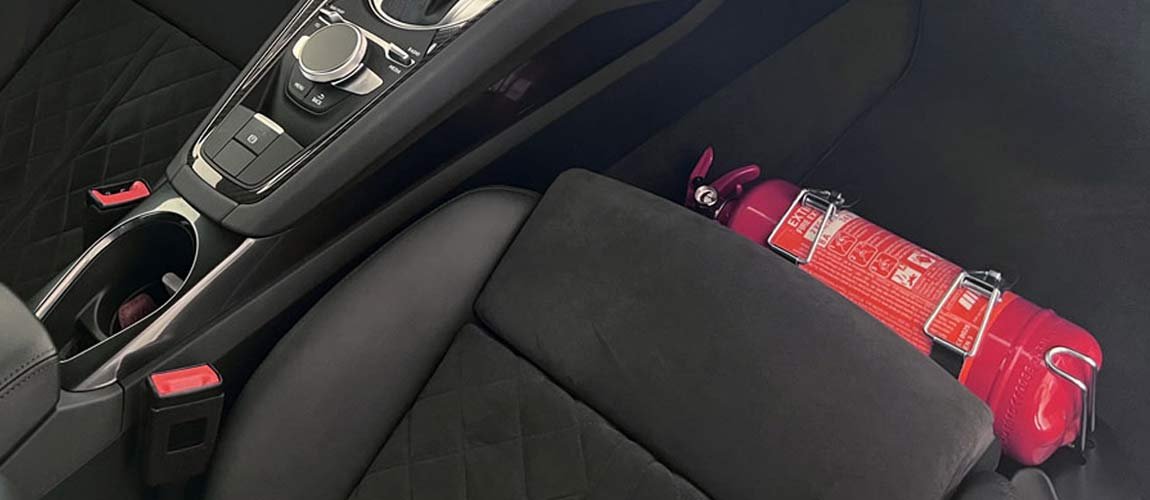
Yes, in practice. NASA CCR §15.1 requires a charge indicator showing charge status, with any gaugeless bottle weighed to confirm its contents — so a unit without a pressure gauge has to be verified another way before it is accepted. Stored-pressure handhelds, which are nearly everything sold for cockpit use, carry a dial that must read inside the green band on the day, driven by a nitrogen propellant behind the agent.
A CO2 bottle, a cartridge-operated unit or a non-pressurised format has no standing gauge, and the fallback weigh-check depends on the inspector having a scale and the time to use it — which leaves some formats an open acceptance question rather than a settled one. A verifier can resolve the question before travelling by photographing the dial; a first-time entrant usually discovers it in the queue. Check the needle in the paddock, not at the tech table.
FIA has required two-yearly servicing of every onboard extinguisher, by a manufacturer-approved agent, since 1 January 2018, and FIA caps extinguisher bottle age at ten years independent of service history or condition. SFI Specification 17.1 runs the same two-year clock from the date of filling. That service interval is the two-year clock every competition bottle lives on, whichever of the two documents applies to your entry.
A scrutineer treats an illegible service label as no label at all, because an unreadable label proves neither the service date nor the date of manufacture. A faded sticker therefore fails a bottle that is technically in date. A rechargeable extinguisher can be recharged and returned to service, and a hydrostatic test governs the cylinder itself on a longer cycle. Those rules together convert an extinguisher from a one-off purchase into a scheduled consumable, and that recurring cost is what buyers leave out when they weigh a $90 unit against a $400 one. A verifier pricing a season and a first-time entrant pricing a single event reach different conclusions from the same arithmetic.
NASA CCR §15.1 bars plastic-bodied bottles and aerosol-type cans outright, which disqualifies most of the sub-$30 parts-store shelf before any rating is read. The plastic clip supplied in a retail extinguisher box is disqualifying hardware at a club tech table for the same reason: the rule asks for metal, and the clip in the box is not it. Three formats and fittings account for most refusals:
A competition car running a plumbed system also carries a red “E” in a white circle marking the actuation point for marshals, alongside its safety pin and tamper seal. Cars fail for a missing or illegible decal as readily as for missing hardware, which surprises builders who inspected only the mechanical items. Every tech inspection fail item on that list is visible at home under a work light. Check the body material, the fastening and the decals before you leave, because none of the three can be fixed in the tech queue.
SCCA and NASA write into the extinguisher rule that the bracket shall be metal, fixed with nuts and bolts rather than sheet-metal screws. Putting the bracket inside the extinguisher clause makes cockpit mounting a rule object, not an accessory: it is inspected as part of the unit, so a compliant bottle in a non-compliant mount fails as one item.
The clause names sheet-metal screws because they thread into thin panel and strip out under crash load, releasing a charged cylinder into the cockpit at the moment the driver is least able to avoid it. A metal mounting bracket is therefore a crash-retention part carrying g-load, not a holder. Bracket failure under impact is the failure mode the wording exists to prevent. Three fastening decisions follow from that clause:
A builder reads this as fabrication practice and a first-time entrant reads it as a shopping constraint, and both arrive at the same conclusion. Treat the mount as a safety-critical part rather than a bracket, and buy it in the same decision as the bottle.
A compliant motorsport installation uses a quick-release bracket that frees the unit one-handed while restraining it against braking, cornering and impact loads. Those two demands pull against each other, which is why the mechanism is written into the rule rather than left to the buyer, and why it is the single most-failed mounting detail at tech.
Cam-locking and over-centre band clamps satisfy both demands by holding the bottle under tension until a lever is thrown. A compliant quick-release mount built for competition is specified around that opposition, not around convenience. Cylinder diameter decides whether the clamp closes at all: a 2.5 lb bottle and a 5 lb bottle do not share an extinguisher clamp, and an oversized band works loose under vibration until the gross mounted mass shifts. A club racer swapping agents mid-season hits that limit the same way a builder does on a first fit, which is why a quick-release clamp kit ships with clamps sized to the bottle rather than a single band. Measure the bottle before you buy the mount, not after, because diameter is a purchase-blocking specification, not an adjustment.
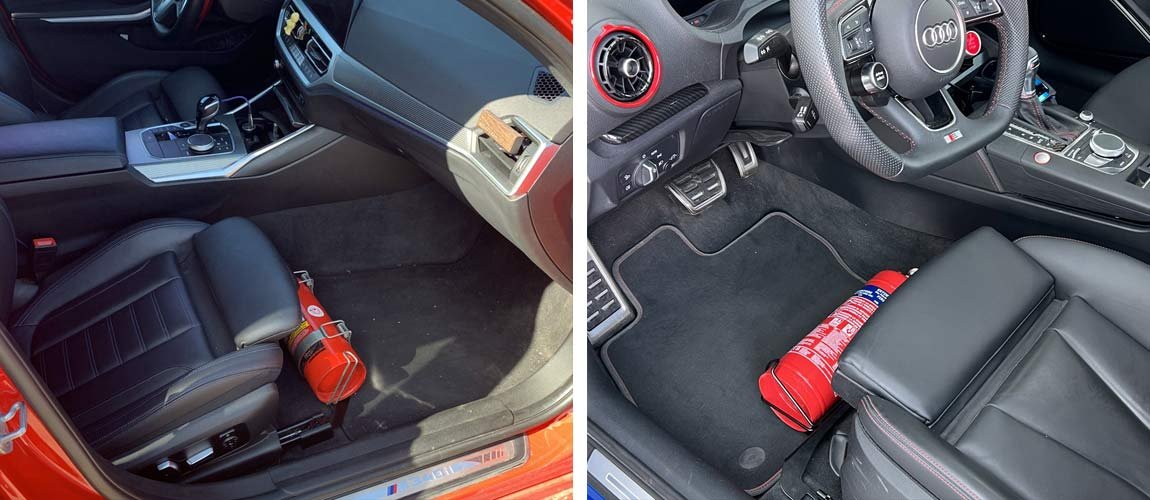
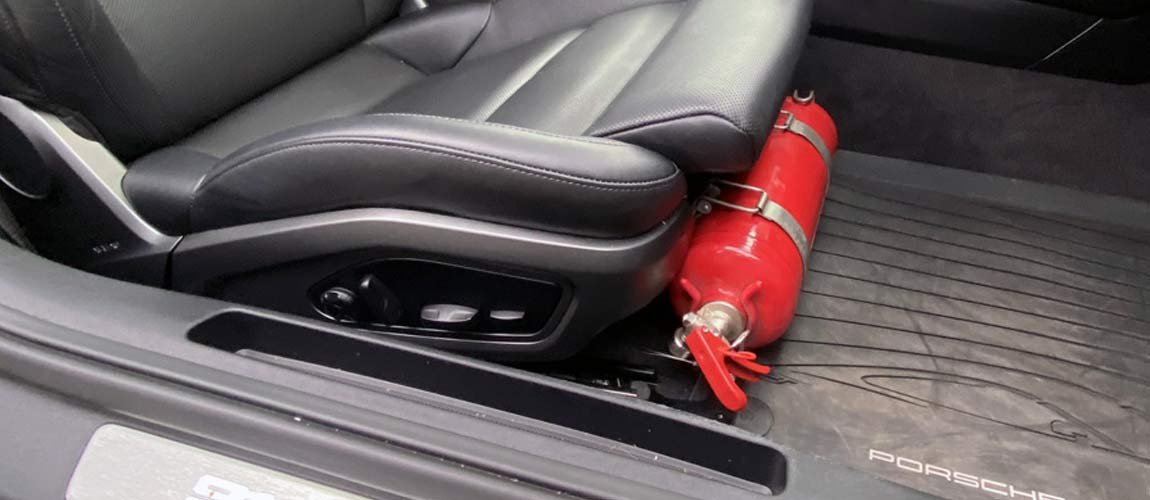
NASA CCR §15.1 places the unit within reach of a driver seated normally, belted, with the steering wheel fitted — three conditions that turn a vague instruction into a five-second physical check an inspector performs at the car. Those conditions rule out the boot, the rear seat and the behind-the-seat positions road cars normally use, because a racing harness fixes the driver in place and a window net narrows the working envelope further. The positions that survive the belted reach test are the passenger footwell, the transmission tunnel and the passenger-side seat rail, with a harness bar or cage tube working only where the driver can still reach it belted:
A builder siting a fire extinguisher in race car conditions is solving driver’s reach first and packaging second, which is the reverse of how a road installation is planned; the road-car guide adds the positions this clause never has to judge, including dashboard and console mounting risks. Sit in the car with the belts done up and try it before the bracket is drilled or bolted.
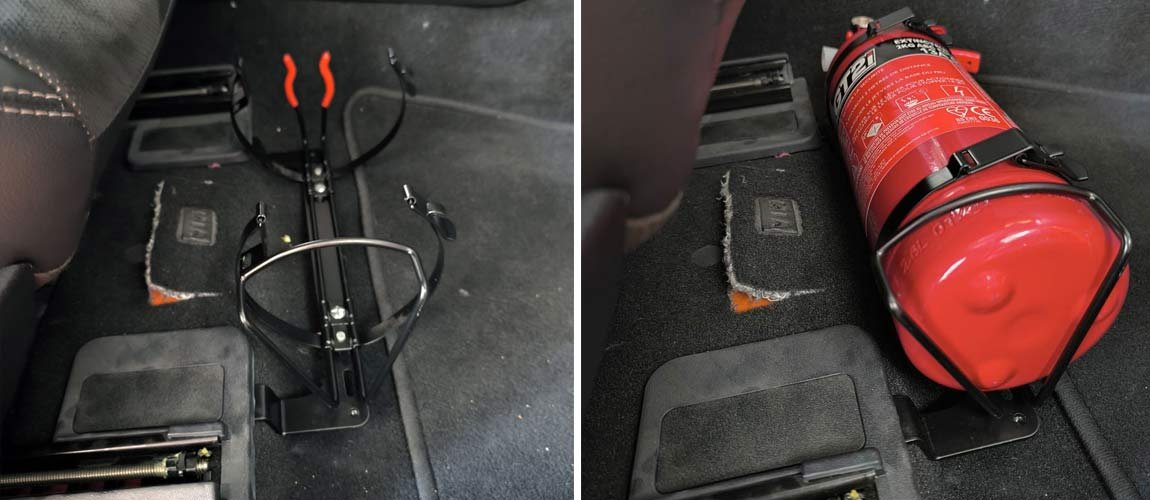
A no-drill bracket bolts through existing factory hardware points whose anchorage strength is governed by FMVSS 210, the federal seat-belt anchorage standard — which makes a factory anchor a load-rated attachment rather than a convenience. A Mazda MX-5 track build keeps its factory seat rails, and a model-specific bracket in 3 mm laser-cut steel, powder-coated, bolts to them without a hole in a car that still drives home. The same applies to an E36 or E46 M3, a Civic Si, a WRX or a 944, and F4Fabrication builds the seat-rail pattern per make and model for that reason.
A caged car takes a different route: it clamps the track car fire extinguisher to a roll-bar or cage tube of matched outside diameter, typically 1.5 in or 1.75 in, and a roll-bar clamp sized to the wrong tube will not close. Outside diameter is the specification that decides whether a cage mount fits at all, and it is measured rather than assumed. Where the car keeps its interior, the no-drill method leaves the shell untouched, and the install guide walks the bracket’s seat-rail bolt sequence step by step. Match the bracket to the structure your car actually has, then re-run the reach test with the bottle in its final position.
A plumbed suppression system fights fire where a belted driver cannot reach, through hard lines to fixed cockpit and engine-bay nozzles — and that reach, not nozzle count or bottle size, is the whole comparison. A race car fire suppression system and a handheld fire extinguisher answer two different questions about the same car. The split is clean:
Neither replaces the other, and many competition cars carry both, which is why paddock vernacular treats fire bottle racing hardware and a fire extinguisher race entrants can grab as separate line items, not alternatives. A first-time entrant rarely needs the decision; a club racer usually finds it already made. No handheld satisfies a class that mandates a system — and where no mandate applies, a compliant handheld in a compliant bracket is the complete answer. Your category usually makes the decision rather than your preference.
FIA mandates a plumbed 8865-2015 system for WRC, R5, R3, R2, WRX, GT3, T1, RG-T and TCR, so anyone competing in a named category has no comparison left to make. SCCA reaches the same outcome from a different direction, requiring an SFI- or FIA-approved fire system in any car first registered after 1 January 2009. The category you enter sets your series-mandated system class, not the car you enter it with. Three routes bring a car inside a mandate:
Grassroots endurance series such as ChampCar Endurance Series and 24 Hours of Lemons sit between the two poles with their own published requirements. Everything not named in one of those lists is exempt by omission, which is the position most HPDE and time-trial entrants occupy without realising it. Find your category first, and only then compare a racing fire suppression system against the handheld you already own.
A mechanical pull-cable head fires a plumbed system without electrical dependency, which is what matters once a crash has killed the electrical system. It is the simplest, cheapest and most widely accepted actuation route at club level. A T-handle pull cable running to the actuator head is the whole mechanism. An electrically actuated head adds push-button and multi-point triggering to a race car fire system at the cost of a loom and a control module that a fire may already have damaged, which is the trade-off a SPA fire system buyer weighs against convenience.
A competition car with a plumbed system also carries an externally accessible actuation point beside the master electrical cut-off switch, so a marshal can fire it with the driver unconscious or the door jammed. Routing hard lines and siting nozzles is a build in its own right, and nozzle placement belongs with that work rather than with a purchase decision. Inspectors check both that the exterior handle exists and that it can actually be operated with the car as raced, gloves on and bodywork fitted.
The shortlist below ranks on acceptance first and performance second, because a superlative settled against a review rather than a rulebook is the wrong answer to this question. Every racing car fire extinguisher named here carries a certification mark a scrutineer can read, a rated capacity at or above the floor its rule set publishes, and a mounting arrangement that survives the bracket clause.
A first HPDE weekend in a street-bodied, uncaged car is answered by a specification rather than by a brand: a UL-listed handheld rated 10 B:C or 1A:10B:C, holding at least the SCCA 2 lb floor, bought in the same order as a metal quick-release bracket. Nothing above that floor buys acceptance, and the supplementary regulations for your specific event are the only document that can ask for more. Buy to that string first, because every escalation past it belongs to a class an uncaged HPDE car does not enter.
Prices and specifications move, so verify the current listing and the current homologation before you buy. A verifier checking a quoted part number and a first-time entrant reading a product page are both looking at a snapshot, not a registry, and acceptance is checked against a document while desirability is judged afterwards. Where a unit’s acceptance is genuinely open rather than settled, this page says so instead of guessing — the open cases are listed separately, not quietly ranked among the settled ones.
Seven accepted units line up on six attributes a scrutineer or a buyer can check, ordered by the rule set each one clears:
| Unit | Certification mark | Rated capacity | Agent | Bracket arrangement | Rule sets cleared | Price band |
|---|---|---|---|---|---|---|
| Safecraft PB-series handheld | SFI 17.1 tag, dated on the bottle | At or above the SCCA 2 lb floor | Named on the unit’s own tag | Supplied to clear the metal quick-release bracket clause | SCCA and NASA club racing | Set by SFI certification and its two-year clock — verify the current listing |
| Safecraft LT-series plumbed system | SFI 17.1 tag, dated on the bottle | Specified as a system rather than a cockpit handheld charge | Named on the unit’s own tag | Mechanical or electric head on one platform, without changing bottles | SCCA’s post-2009 first-registration clause | Set by SFI certification and its two-year clock — verify the current listing |
| Stroud Safety suppression system | Read the SFI tag on the unit you are quoted | Specified as a system | Named on the unit’s own tag | System plumbing rather than a cockpit clamp | Drag classes where elapsed time rather than category drives the mandate | Verify the current listing |
| Sparco 2.4 litre AFFF handheld | FIA homologation on the current FIA Technical List | 2.4 litres | AFFF | Ships as a mounted set with bracket and quick-release straps | FIA Appendix J Article 253.7 | Verify the current listing |
| OMP Racing 2.4 litre AFFF handheld | FIA homologation on the current FIA Technical List | 2.4 litres | AFFF | Ships as a mounted set with bracket and quick-release straps | FIA Appendix J Article 253.7 | Verify the current listing |
| Lifeline 2.4 litre AFFF handheld | FIA homologation on the current FIA Technical List | 2.4 litres | AFFF | Supplied with bracket and quick-release straps | FIA Appendix J Article 253.7 | Verify the current listing |
| Lifeline Zero 360 | FIA homologation on the current FIA Technical List, and SCCA-legal | 2.25 kg and 3.0 kg | Novec 1230 (FK-5-1-12) | Mechanical or electrical head, with bottle orientation fixed at the design stage | FIA and SCCA together, from one purchase | Carries both the two-year service interval and the ten-year bottle-age cap — verify the current listing |
Two entries sit outside that table because their acceptance is unsettled rather than proven, and they are listed on the same six attributes so the gap is visible, not hidden:
| Unit | Certification mark | Rated capacity | Agent | Bracket arrangement | Rule sets cleared | Price band |
|---|---|---|---|---|---|---|
| Element E100 | None of the three marks, and no gauge for an inspector to read | Hundred-second discharge from a potassium aerosol stick, with no cylinder and no valve | Potassium aerosol | Roll bar mount sold separately at $74.95; the Motorsport Bundle pairs unit, mount and marking decals | Rule collision under NASA CCR §15.1, which requires a charge indicator and bars aerosol-type cans — a question for your tech steward | $119.95 listed; Motorsport Bundle $194.91, reduced from $214.90 |
| Cold Fire | None — operational provenance rather than a certificate | Ask your tech steward | Ask your tech steward | Ask your tech steward | Neither a mark nor a listing; carried by the safety crews at Indianapolis Motor Speedway, Charlotte Motor Speedway and Watkins Glen, and by IRL, NHRA, IHRA, DIRT and IMSA | Verify the current listing |
Safecraft Safety Equipment builds SFI 17.1-certified plumbed systems and motorsport handhelds, and it is the American supplier a club racer shortlists first when a class forces the move off a handheld. A Safecraft fire extinguisher or system is specified rather than styled, which suits an auto racing fire extinguisher bought to clear a rule.
Its PB-series bottles and LT-series systems carry the SFI 17.1 tag and the two-year recertification clock behind it, which is what a certified unit is priced against, not the bottle alone. Safecraft offers mechanical and electric heads on the same platform, so a car can start mechanical and move to electric actuation without changing bottles. Stroud Safety covers the drag-oriented end of the same market, and a Stroud fire suppression system reaches classes where elapsed time rather than category drives the mandate.
Both are specified against a rule rather than chosen on brand. Check the SFI tag date on the unit you are quoted, whether it is new stock or a system moving with a sold car, because a certified system that is out of recertification is treated exactly like an uncertified one. A verifier buying second-hand carries that risk in full.
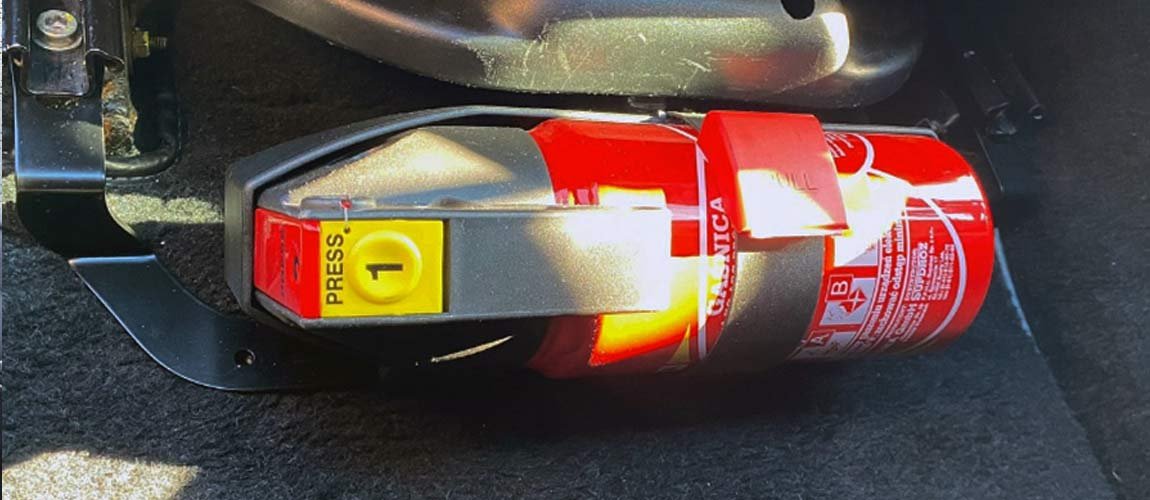
An FIA-homologated handheld is the default fitment in FIA-regulated paddocks, and the 2.4 litre AFFF unit is the size that satisfies Appendix J Article 253.7 for hand-held use. That figure, rather than a brand preference, narrows the shortlist before any spec sheet is opened. Lifeline, Sparco and OMP Racing each publish AFFF handhelds in that class, supplied with a bracket and quick-release straps as a set, not as a bare bottle:
Buying a set matters, because a bare bottle still needs a compliant clamp before it clears tech. Catalogue availability makes fire extinguisher racing purchases straightforward for an entrant travelling to an event abroad who needs a mark the local scrutineer recognises. Confirm the unit appears on the current FIA Technical List before you rely on the homologation, and check the service date on arrival rather than on the first grid.
The Lifeline Zero 360 line is simultaneously FIA-homologated and SCCA-legal, supplied in 2.25 kg and 3.0 kg Novec 1230 form — the FK-5-1-12 clean agent — with mechanical or electrical heads. That is the rare case where one purchase closes two rule sets instead of one. It matters if you run a car across both a US club season and an FIA-permit event, because the alternative is buying twice. An FIA fire suppression system of that class carries costs alongside the coverage:
| Attribute | Zero 360 line |
|---|---|
| Sizes | 2.25 kg and 3.0 kg |
| Agent | Novec 1230 (FK-5-1-12) |
| Heads | Mechanical or electrical |
| Service exposure | Both the two-year interval and the ten-year age cap |
That dual coverage carries the running cost of both regimes — the two-year service interval and the ten-year bottle-age cap together — and bottle orientation has to be settled at the design stage rather than at fitting. SPA Technique sits alongside it as an electric-actuation alternative for builders who want push-button triggering on the same dual-jurisdiction logic. Verify the line’s current entry on the FIA Technical List instead of relying on a homologation number quoted in a catalogue, because catalogue numbers age faster than the registry does.
The Element E100 raises an acceptance question under NASA CCR §15.1 instead of answering one, because it presents no gauge for an inspector to read and it discharges as an aerosol — and NASA’s clause requires the first and bars the second. That is a rule collision, and it is a question for the tech steward running your event rather than a verdict this page can issue.
Element positions the E100 as its professional unit, recommended for automotive, racecar and side-by-side use, and lists it at $119.95 against the 50-second E50 consumer sibling at $89.95. An E100 Motorsport Bundle at $194.91, reduced from $214.90, pairs the unit with a roll bar mount and marking decals, and that mount is sold separately at $74.95. The hundred-second discharge is roughly ten times a conventional handheld’s, delivered from a potassium aerosol stick with no cylinder, no valve and no gauge, which places the unit outside the gauge, expiry and hydrostatic-test regime entirely.
Cold Fire sits in a different category again: it is carried by the safety crews at Indianapolis Motor Speedway, Charlotte Motor Speedway and Watkins Glen, and by IRL, NHRA, IHRA, DIRT and IMSA — operational provenance rather than a certificate. A first-time entrant reads that as endorsement; a scrutineer reads it as neither a mark nor a listing. Ask your tech steward before the event, not at the table.
Once the rulebook is satisfied, the remaining decisions are yours rather than the scrutineer’s, and they come down to what a discharge costs you afterwards and how the unit behaves in your hands. Two units that both pass tech can leave very different cars behind.
A dry chemical blanket corrodes aluminium, connectors and looms long after the flame is out, while a halocarbon clean agent evaporates and leaves the electronics working, which is the difference between a repair bill and a working loom. Weight, bottle orientation, refill availability and the local service network all sit in the same discretionary layer, and a club racer weighs them differently from a first-time entrant who discharges nothing in a season. Refill availability alone decides how quickly a discharged unit returns to the car, how far you drive to make that happen, and whether it comes back with a legible date inside its two-year window. Those trade-offs run wider than motorsport, and the full agent comparison covers what each agent leaves behind across every class rather than only the ones a race rulebook names.
A belted driver operates a handheld by pulling the pin, aiming at the base of the fire, squeezing the lever and sweeping — one-handed, through a window net, with the racing harness still fastened:
Every step of that PASS technique is harder in a cockpit than in a car park, and the difference is the constraint rather than the technique. Practise the release from the bracket while belted, because the seconds you lose fighting the clamp come out of the eight to fourteen you have. A builder can rehearse it in the garage; an entrant borrowing a car cannot. Get out first if the fire is behind the bulkhead.
A dry chemical blanket corrodes aluminium, connectors and looms long after the flame is out, while a halocarbon clean agent evaporates and leaves the electronics working, which is the difference between a repair bill and a working loom. Weight, bottle orientation, refill availability and the local service network all sit in the same discretionary layer, and a club racer weighs them differently from a first-time entrant who discharges nothing in a season. Refill availability alone decides how quickly a discharged unit returns to the car, how far you drive to make that happen, and whether it comes back with a legible date inside its two-year window. Those trade-offs run wider than motorsport, and the full agent comparison covers what each agent leaves behind across every class rather than only the ones a race rulebook names.
A lithium-ion thermal runaway in an electrified track car resists handheld suppression: surface knockdown is possible, internal propagation is not stopped, and the pack will reignite once cell-to-cell heating continues. Surface knockdown buys time to leave the car and nothing more. A Class D magnesium fire defeats every handheld agent a club rulebook permits, and water-based agents react violently with it rather than smothering it.
A cockpit handheld buys the seconds a driver needs to evacuate before a trackside fire marshal arrives with far larger capacity — that is the job it is sized for, and no unit on the market changes the arithmetic. A verifier comparing spec sheets and an entrant comparing prices are both choosing inside that boundary rather than escaping it. Knowing the boundary makes the rest of the equipment worth carrying, and keeps driver extraction ahead of firefighting in the order of decisions.
Six questions recur at tech tables and in entry paperwork, and a named document settles each one rather than a preference.
FIA Standard 8865-2015 is the current specification for plumbed-in and hand-held fire extinguisher systems, and homologated systems are published on FIA Technical List n°52 — not Technical List n°16, which lists the legacy 1999 plumbed-in standard. FIA Standard 8876-2022 now appears on Technical List n°97 and succeeds the 8865-2015 generation. For hand-held use, FIA Appendix J Article 253.7 sets 2.4 litres of AFFF or 2.0 kg of gas or powder. Check which standard your series runs this season.
It depends on the organiser, and many word it as strongly recommended rather than mandatory. Porsche Club of America, BMW Car Club of America, NASA HPDE and SCCA Track Night in America each publish their own minimum standards, and the supplementary regulations for your specific event are the document that decides it. A compliant fire extinguisher for track day use, mounted in a metal quick-release bracket, satisfies every organiser that asks for one, so carrying it removes the question.
They come from two different systems. B1 and B2 are US Coast Guard marine size classifications for boats, and they say nothing about a car’s tech inspection. 10 B:C is a UL fire-test rating string, and it is the one SCCA quotes: the number states the measured flammable-liquid capability and the letters name the fire classes the unit was tested against. Read the UL or EN 3 rating on the nameplate, not a marine class.
FIA has required two-yearly servicing of every onboard extinguisher, by a manufacturer-approved agent, since 1 January 2018, and caps bottle age at ten years regardless of condition. SFI Specification 17.1 runs the same two-year clock from the date of filling. A scrutineer reads the date off the label, so an illegible sticker fails a bottle that is technically in date. Replace the label before the season, not at the tech table.
Sometimes the bottle will, but the mounting rarely does. Most retail units ship with a plastic clip, and SCCA and NASA both require a metal bracket fixed with nuts and bolts rather than sheet-metal screws. NASA CCR §15.1 also bars plastic-bodied bottles and aerosol-type cans outright. Check the body material, the rating string, the charge indicator and the bracket before you assume a shelf unit will clear the tech table.
Usually not. Autocross carries the lightest fire-equipment requirement of any competition format, and many events do not require an entrant to carry one. That is a rule position rather than a risk position, because a low-speed course still runs cars with fuel and heat. Buy to the stricter rule set once where the same car does track days or time trials, and run that autocross fire extinguisher everywhere instead of buying twice.
The best fire extinguisher for track days and motorsport is the smallest unit that clears your rulebook’s floor, carries a mark your scrutineer can read, and mounts in metal within belted reach. Nothing above that floor buys acceptance, and nothing below it survives the tech table. Work the five conditions in order before you buy:
Buy the bottle and the mount as one decision, because tech inspection judges them as one item — and the bracket is the half a retail box gets wrong. F4Fabrication cuts that pattern per chassis rather than adapting a universal clamp. A first-time entrant and a logbooked club racer arrive at the same five questions from opposite ends of the paddock, and both end at the same shelf of fire extinguisher mounting solutions built per make and model. Answer them in that order and the purchase settles itself.